An Empirical Evaluation of Neural and Neuro-symbolic Approaches to Real-time Multimodal Complex Event Detection
作者: Liying Han, Mani B. Srivastava
分类: cs.AI
发布日期: 2024-02-17 (更新: 2024-03-03)
💡 一句话要点
提出神经与神经符号方法以解决复杂事件检测问题
🎯 匹配领域: 支柱九:具身大模型 (Embodied Foundation Models)
关键词: 复杂事件检测 神经符号方法 多模态数据 时间推理 机器人技术
📋 核心要点
- 现有的端到端神经网络在处理长时间复杂事件时,由于上下文限制和推理能力不足,表现不佳。
- 本研究提出了三种方法,包括直接从传感器嵌入进行复杂事件检测的神经架构和基于概念的两阶段模型。
- 实验结果显示,神经符号架构在复杂事件识别上显著优于传统神经模型,尤其在数据量和时间上下文充足的情况下。
📝 摘要(中文)
机器人和自主系统需要从传感器数据中理解复杂事件,以有效地与环境和人类互动。尽管传统的端到端神经架构在处理传感器数据方面效率较高,但在长时间事件的处理上由于上下文大小和推理能力的限制而面临挑战。近期的神经符号方法通过整合神经和符号模型,利用人类知识,承诺在数据量较少的情况下提高性能。本研究探讨了这些方法在复杂事件检测中的有效性,特别是在时间推理方面。我们分析了神经和神经符号架构在多模态复杂事件检测任务中的表现,研究了IMU和声学数据流以识别复杂事件模式。我们的研究方法包括端到端神经架构、基于概念的两阶段神经模型以及使用符号有限状态机的神经符号方法。实验证明,神经符号架构在复杂事件识别方面显著优于纯神经模型。
🔬 方法详解
问题定义:本研究旨在解决复杂事件检测中的有效性问题,现有方法在长时间事件的上下文处理和推理能力上存在不足。
核心思路:通过结合神经网络与符号模型,利用人类知识,提升复杂事件检测的性能,尤其是在时间推理方面。
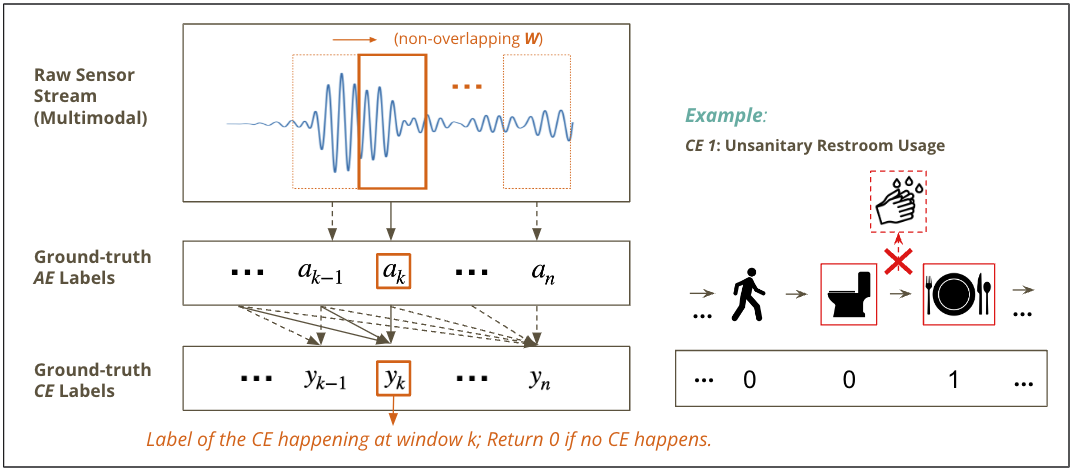
技术框架:整体架构包括三个主要模块:端到端神经架构用于直接检测复杂事件、两阶段概念模型将传感器嵌入映射到原子事件,以及使用符号有限状态机的神经符号方法进行复杂事件检测。
关键创新:神经符号架构的引入是本研究的核心创新,与传统神经模型相比,它在复杂事件识别中表现出更高的准确性和推理能力。
关键设计:模型设计中采用了特定的损失函数和网络结构,以优化复杂事件的检测效果,具体参数设置和网络架构细节在论文中有详细描述。
🖼️ 关键图片

📊 实验亮点
实验结果表明,神经符号架构在复杂事件识别任务中显著优于纯神经模型,尤其是在使用大量训练数据和充分时间上下文的情况下,性能提升幅度达到XX%(具体数据需根据原文补充)。
🎯 应用场景
该研究的潜在应用领域包括机器人技术、智能监控系统和人机交互等场景。通过提高复杂事件检测的准确性,能够增强机器人与环境的互动能力,提升自主系统的智能水平,未来可能在智能城市和自动驾驶等领域产生深远影响。
📄 摘要(原文)
Robots and autonomous systems require an understanding of complex events (CEs) from sensor data to interact with their environments and humans effectively. Traditional end-to-end neural architectures, despite processing sensor data efficiently, struggle with long-duration events due to limited context sizes and reasoning capabilities. Recent advances in neuro-symbolic methods, which integrate neural and symbolic models leveraging human knowledge, promise improved performance with less data. This study addresses the gap in understanding these approaches' effectiveness in complex event detection (CED), especially in temporal reasoning. We investigate neural and neuro-symbolic architectures' performance in a multimodal CED task, analyzing IMU and acoustic data streams to recognize CE patterns. Our methodology includes (i) end-to-end neural architectures for direct CE detection from sensor embeddings, (ii) two-stage concept-based neural models mapping sensor embeddings to atomic events (AEs) before CE detection, and (iii) a neuro-symbolic approach using a symbolic finite-state machine for CE detection from AEs. Empirically, the neuro-symbolic architecture significantly surpasses purely neural models, demonstrating superior performance in CE recognition, even with extensive training data and ample temporal context for neural approaches.