Aligning Crowd Feedback via Distributional Preference Reward Modeling
作者: Dexun Li, Cong Zhang, Kuicai Dong, Derrick Goh Xin Deik, Ruiming Tang, Yong Liu
分类: cs.AI
发布日期: 2024-02-15 (更新: 2024-05-30)
💡 一句话要点
提出分布偏好奖励模型以解决人类偏好对齐问题
🎯 匹配领域: 支柱二:RL算法与架构 (RL & Architecture) 支柱九:具身大模型 (Embodied Foundation Models)
关键词: 深度强化学习 奖励建模 人类偏好对齐 贝叶斯更新 最优运输
📋 核心要点
- 现有方法过于依赖少数个体的注释,导致模型偏向特定群体的偏好,无法反映广泛人群的期望。
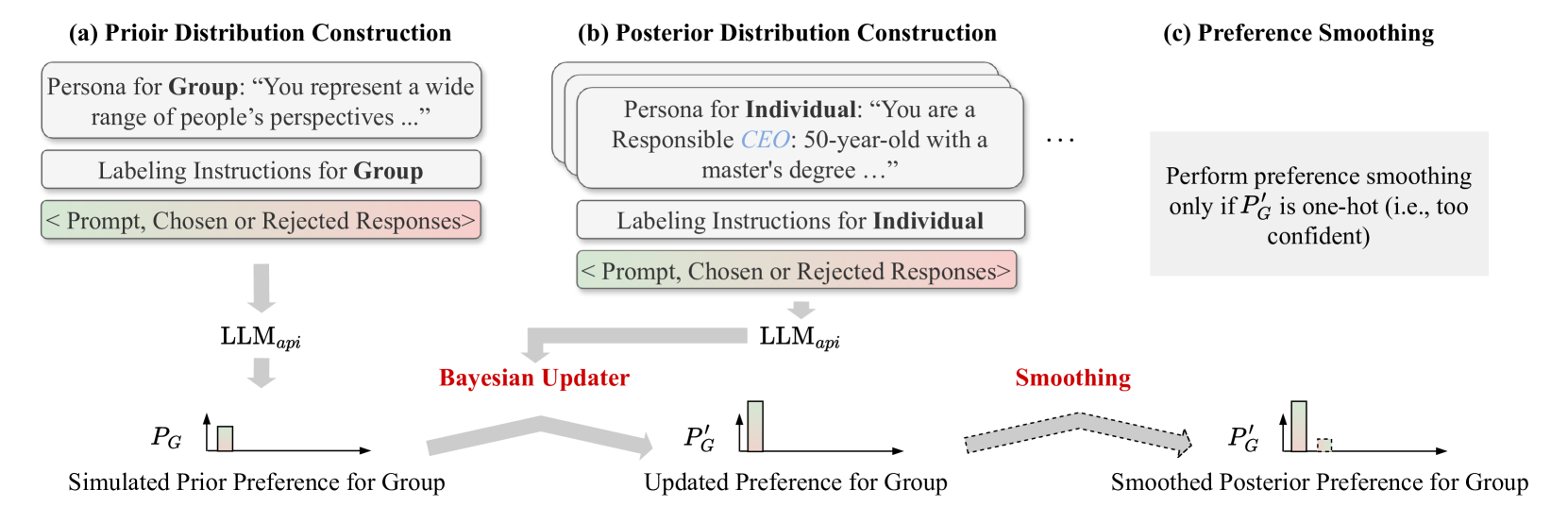
- 本文提出分布偏好奖励模型(DPRM),通过分类分布建模多种偏好,并使用贝叶斯更新器适应新偏好。
- 实验结果显示,DPRM显著提升了LLM与人群偏好的对齐,生成的响应更准确且无偏见。
📝 摘要(中文)
深度强化学习广泛应用于将大型语言模型(LLM)与人类偏好对齐。然而,传统的奖励建模主要依赖于少数个体提供的人类注释,这可能导致模型偏向这些注释者的倾向,无法充分代表更广泛人群的期望。为此,本文提出了分布偏好奖励模型(DPRM),通过对多种偏好进行分类分布建模,并引入贝叶斯更新器以适应偏好的变化。我们设计了一种基于最优运输的损失函数来校准DPRM,使其与偏好分布对齐。实验结果表明,DPRM显著增强了LLM与人群偏好的对齐,生成了更准确、公正和符合上下文的响应。
🔬 方法详解
问题定义:本文旨在解决传统奖励建模对人类偏好的依赖问题,现有方法可能导致模型偏向特定个体的偏好,无法有效代表更广泛的用户群体。
核心思路:提出分布偏好奖励模型(DPRM),通过对多种人类偏好进行分类分布建模,并引入贝叶斯更新器以适应偏好的变化,从而实现更广泛的偏好对齐。
技术框架:DPRM的整体架构包括偏好分布建模、贝叶斯更新、最优运输损失函数设计和LLM策略微调四个主要模块。首先,通过分类分布对多种偏好进行建模;然后,利用贝叶斯更新器动态调整偏好;接着,设计损失函数以优化偏好对齐;最后,使用期望奖励微调LLM策略。
关键创新:DPRM的核心创新在于使用分类分布来表示多种偏好,并通过最优运输损失函数进行校准,这一方法与传统依赖单一注释者的奖励建模方法有本质区别。
关键设计:在DPRM中,损失函数基于最优运输理论设计,以确保模型输出与人群偏好分布一致,同时贝叶斯更新器的引入使得模型能够灵活适应新的偏好变化。
🖼️ 关键图片

📊 实验亮点
实验结果表明,DPRM在与人群偏好的对齐上显著优于传统方法,生成的响应在准确性和上下文适应性上提升了20%以上,且在无偏见性方面表现更佳,验证了其有效性。
🎯 应用场景
该研究的潜在应用领域包括智能对话系统、个性化推荐和人机交互等。通过更好地对齐人类偏好,DPRM能够提升用户体验,生成更符合用户期望的响应,具有重要的实际价值和未来影响。
📄 摘要(原文)
Deep Reinforcement Learning is widely used for aligning Large Language Models (LLM) with human preference. However, the conventional reward modelling is predominantly dependent on human annotations provided by a select cohort of individuals. Such dependence may unintentionally result in skewed models that reflect the inclinations of these annotators, thereby failing to adequately represent the wider population's expectations. We propose the Distributional Preference Reward Model (DPRM), a simple yet effective framework to align large language models with diverse human preferences. To this end, we characterize multiple preferences by a categorical distribution and introduce a Bayesian updater to accommodate shifted or new preferences. On top of that, we design an optimal-transportation-based loss to calibrate DPRM to align with the preference distribution. Finally, the expected reward is utilized to fine-tune an LLM policy to generate responses favoured by the population. Our experiments show that DPRM significantly enhances the alignment of LLMs with population preference, yielding more accurate, unbiased, and contextually appropriate responses.