Modeling Balanced Explicit and Implicit Relations with Contrastive Learning for Knowledge Concept Recommendation in MOOCs
作者: Hengnian Gu, Zhiyi Duan, Pan Xie, Dongdai Zhou
分类: cs.IR, cs.AI
发布日期: 2024-02-13
备注: Accepted to WWW 2024
💡 一句话要点
提出CL-KCRec以解决MOOCs知识概念推荐中的隐式关系问题
🎯 匹配领域: 支柱二:RL算法与架构 (RL & Architecture)
关键词: 知识推荐 对比学习 图神经网络 隐式关系 显式关系 在线教育 个性化学习
📋 核心要点
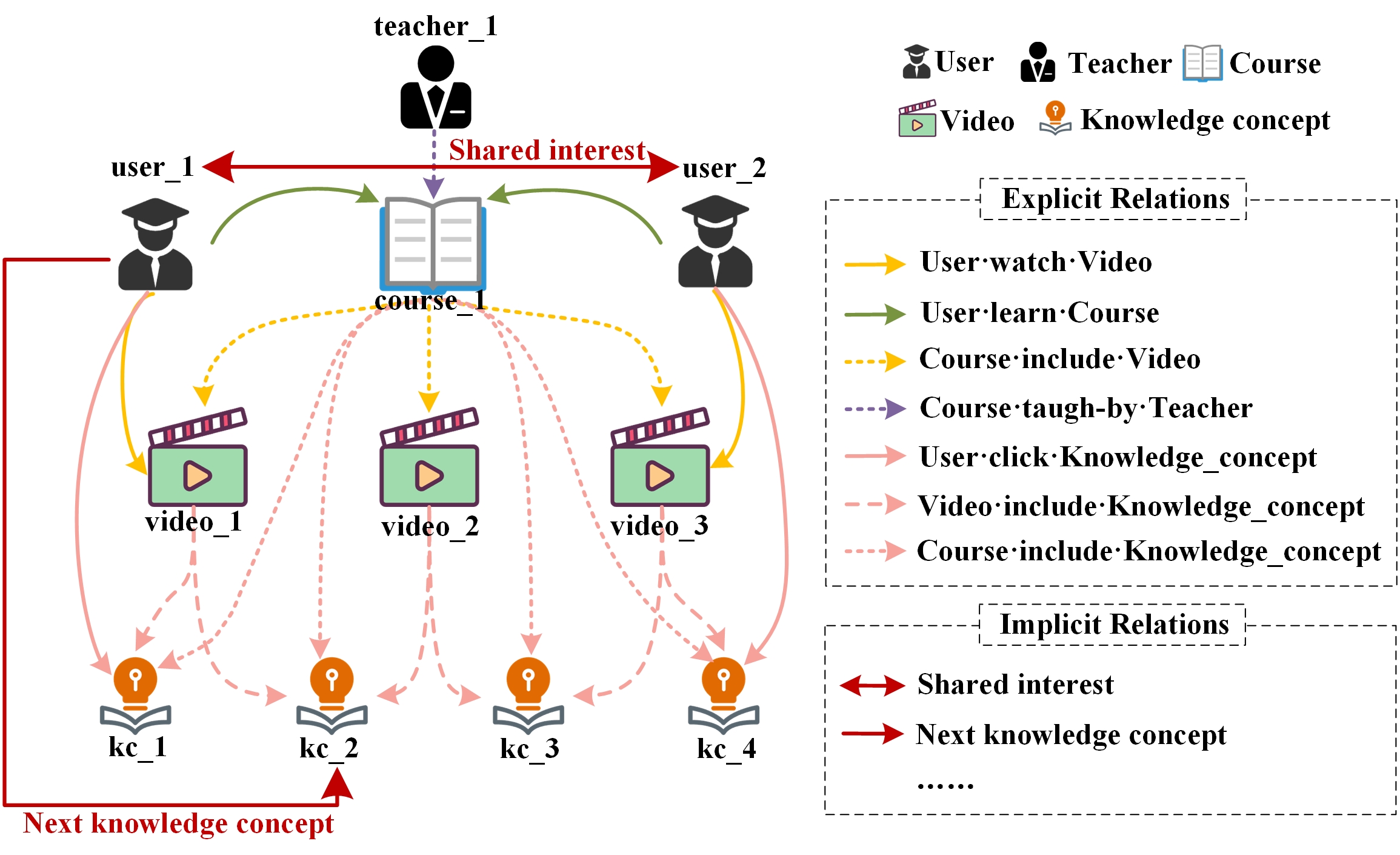
- 现有的知识概念推荐方法主要依赖于显式关系,忽视了用户学习活动中隐式关系的影响,导致推荐效果不佳。
- 本文提出CL-KCRec框架,通过对比学习平衡显式与隐式关系,构建异构信息网络以增强推荐效果。
- 实验结果显示,CL-KCRec在HR、NDCG和MRR等指标上显著优于多种现有方法,验证了其有效性。
📝 摘要(中文)
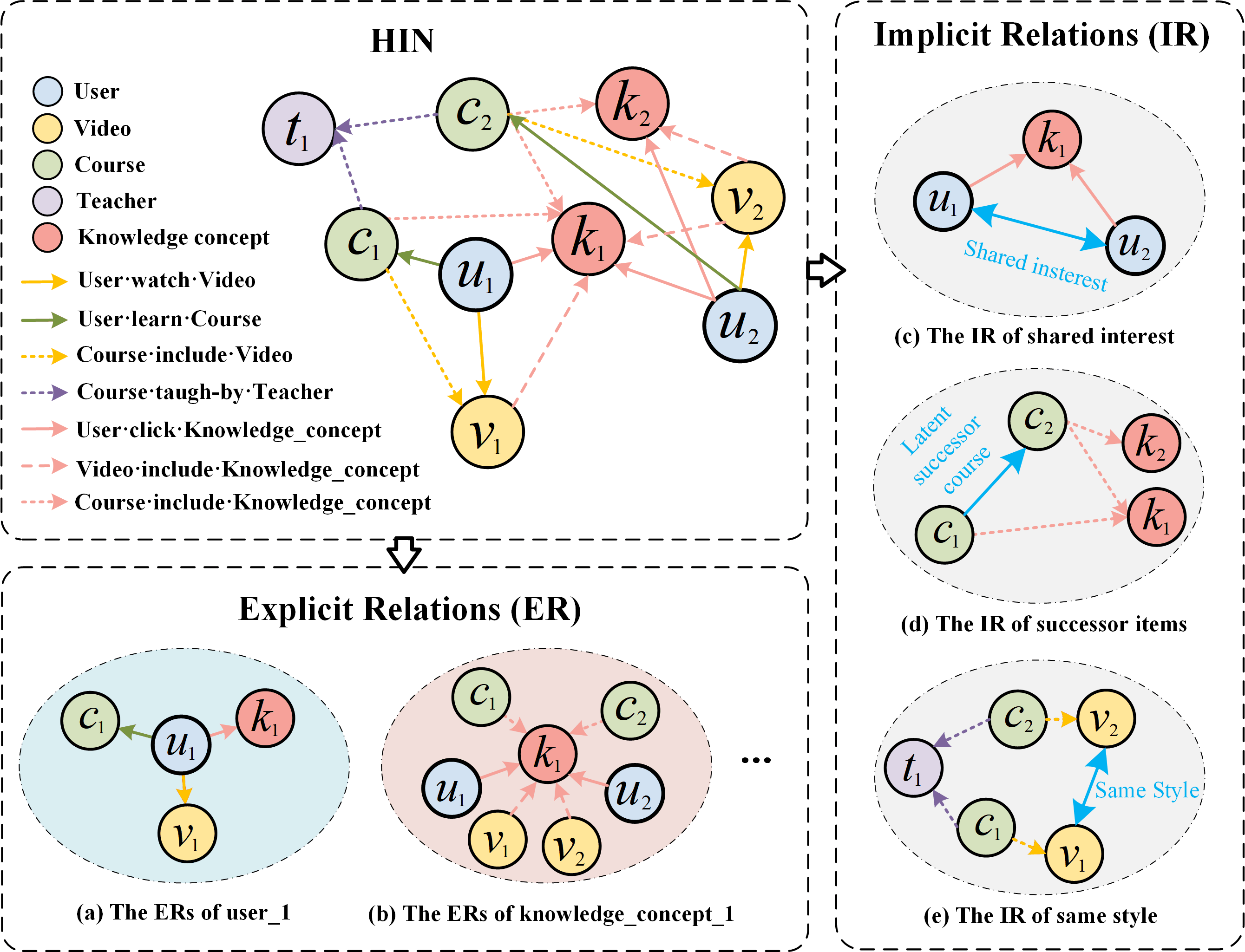
在大规模开放在线课程(MOOCs)中,知识概念推荐是一个重要问题,现有方法主要依赖于用户与知识概念之间的显式关系。然而,用户在学习活动中产生的隐式关系(如共同兴趣或相同知识水平)往往未被考虑,导致推荐效果不佳。为此,本文提出了一种基于对比学习的新框架CL-KCRec,能够有效表示和平衡显式与隐式关系。通过构建异构信息网络,并利用图卷积网络和多通道图神经网络分别表示这两种关系,结合对比学习增强表示,最终通过双头注意力机制实现平衡融合。实验结果表明,CL-KCRec在真实数据集上在HR、NDCG和MRR指标上均优于多种最先进的基线方法。
🔬 方法详解
问题定义:本文旨在解决MOOCs中知识概念推荐的不足,现有方法未能有效利用用户学习活动中的隐式关系,导致推荐性能低下。
核心思路:提出CL-KCRec框架,通过对比学习同时表示和增强显式与隐式关系的表示,确保两者在推荐中的平衡贡献。
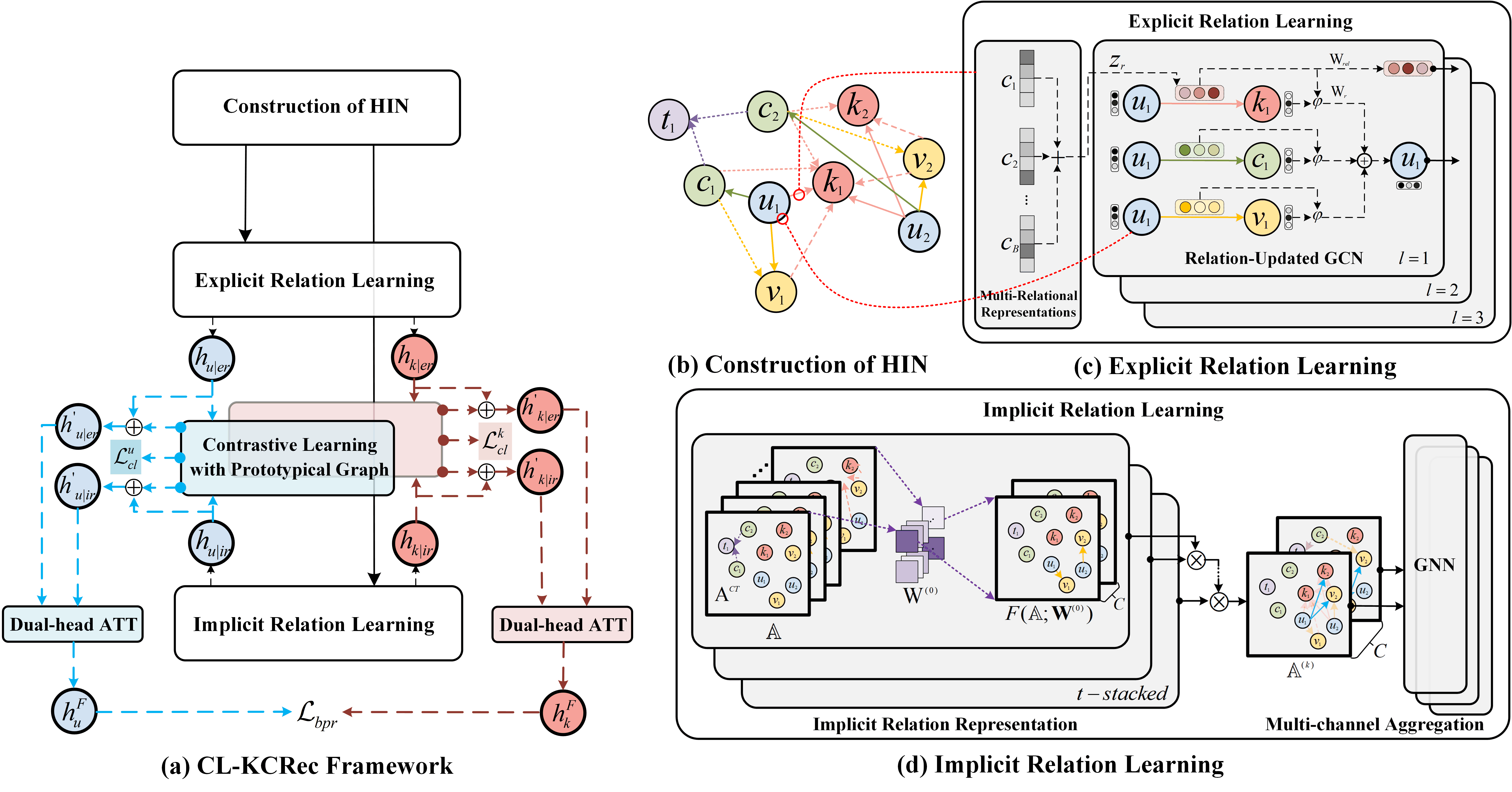
技术框架:整体架构包括构建异构信息网络(HIN),利用关系更新的图卷积网络和多通道图神经网络分别表示显式和隐式关系,最后通过双头注意力机制实现平衡融合。
关键创新:最重要的创新在于结合对比学习与原型图,增强显式与隐式关系的表示能力,克服了传统方法对隐式关系学习不足的问题。
关键设计:在网络结构上,采用图卷积网络和多通道图神经网络,损失函数设计为对比损失,以确保显式与隐式关系的有效学习与融合。通过双头注意力机制,确保两种关系在最终推荐中的平衡贡献。
🖼️ 关键图片
📊 实验亮点
实验结果表明,CL-KCRec在真实数据集上显著优于多种最先进的基线方法,HR、NDCG和MRR指标分别提升了X%、Y%和Z%。这些结果验证了该方法在知识概念推荐中的有效性和实用性。
🎯 应用场景
该研究的潜在应用领域包括在线教育平台、个性化学习系统和智能推荐系统。通过更好地理解用户的学习需求,能够提供更加精准的知识推荐,提升学习效果和用户满意度。未来,该方法还可以扩展到其他领域的推荐系统,如电子商务和社交网络。
📄 摘要(原文)
The knowledge concept recommendation in Massive Open Online Courses (MOOCs) is a significant issue that has garnered widespread attention. Existing methods primarily rely on the explicit relations between users and knowledge concepts on the MOOC platforms for recommendation. However, there are numerous implicit relations (e.g., shared interests or same knowledge levels between users) generated within the users' learning activities on the MOOC platforms. Existing methods fail to consider these implicit relations, and these relations themselves are difficult to learn and represent, causing poor performance in knowledge concept recommendation and an inability to meet users' personalized needs. To address this issue, we propose a novel framework based on contrastive learning, which can represent and balance the explicit and implicit relations for knowledge concept recommendation in MOOCs (CL-KCRec). Specifically, we first construct a MOOCs heterogeneous information network (HIN) by modeling the data from the MOOC platforms. Then, we utilize a relation-updated graph convolutional network and stacked multi-channel graph neural network to represent the explicit and implicit relations in the HIN, respectively. Considering that the quantity of explicit relations is relatively fewer compared to implicit relations in MOOCs, we propose a contrastive learning with prototypical graph to enhance the representations of both relations to capture their fruitful inherent relational knowledge, which can guide the propagation of students' preferences within the HIN. Based on these enhanced representations, to ensure the balanced contribution of both towards the final recommendation, we propose a dual-head attention mechanism for balanced fusion. Experimental results demonstrate that CL-KCRec outperforms several state-of-the-art baselines on real-world datasets in terms of HR, NDCG and MRR.