Monitoring the evolution of antisemitic discourse on extremist social media using BERT
作者: Raza Ul Mustafa, Nathalie Japkowicz
分类: cs.CY, cs.AI, cs.CL, cs.IR, cs.LG, cs.SI
发布日期: 2024-02-06
备注: 11 pages; 4 figures; 4 pages
💡 一句话要点
提出无监督在线机器学习方法监测极端社交媒体上的反犹太主义话语演变
🎯 匹配领域: 支柱九:具身大模型 (Embodied Foundation Models)
关键词: 反犹太主义 社交媒体监测 无监督学习 机器学习 语言模型 仇恨言论 文本分析
📋 核心要点
- 现有方法在监测社交媒体上反犹太主义话语时面临手动监测不切实际的问题,且难以应对大量动态内容。
- 本文提出了一种无监督在线机器学习方法,利用大型语言模型自动提取和监测反犹太主义主题及其演变。
- 实验结果显示,该方法在主题发现和术语提取方面优于现有基线,具有更好的适应性和准确性。
📝 摘要(中文)
社交媒体上的种族主义和不宽容行为助长了有毒的在线环境,可能导致线下仇恨和暴力。本文研究了反犹太主义这一特定仇恨类别,提出了一种自动化方法,能够提取极端社交媒体上的反犹太主义主题及其术语,并监测其演变。由于在线讨论的数量庞大且不断变化,手动监测不切实际,因此我们开发了一种无监督在线机器学习方法,利用大型语言模型评估帖子之间的上下文相似性。实验结果表明,该方法优于现有基线,能够有效发现反犹太主义话语中的主题和子主题及其相关术语。
🔬 方法详解
问题定义:本文旨在解决如何有效监测和分析社交媒体上反犹太主义话语演变的问题。现有手动监测方法无法处理大量动态内容,且难以捕捉细微的主题变化。
核心思路:论文提出了一种无监督在线机器学习方法,通过评估帖子之间的上下文相似性,自动聚类相似帖子,并提取反犹太主义相关术语。这种设计能够适应社交媒体内容的快速变化。
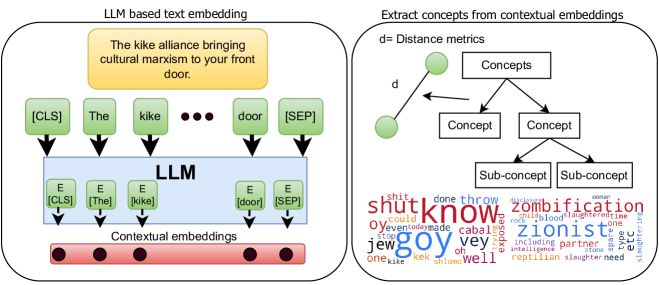
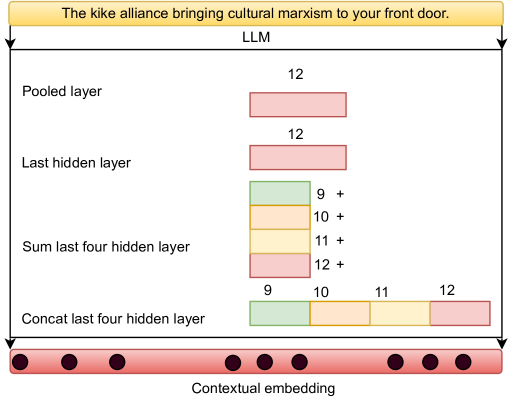
技术框架:整体架构包括数据收集、文本预处理、上下文相似性评估、聚类分析和术语提取等主要模块。数据收集阶段从极端社交媒体平台获取帖子,随后进行文本清洗和特征提取。
关键创新:最重要的创新在于采用无监督学习方法,利用大型语言模型进行上下文相似性评估,克服了传统监督学习的局限性,能够动态适应新出现的主题和子主题。
关键设计:在聚类过程中,采用了动态更新机制,当出现新的子主题或主题时,系统能够自动创建新的聚类。此外,使用了特定的相似性度量方法,以确保聚类的准确性和有效性。
🖼️ 关键图片

📊 实验亮点
实验结果表明,提出的方法在主题发现和术语提取方面显著优于现有基线,具体性能数据未详述,但显示出较高的准确性和适应性,能够有效捕捉反犹太主义话语的演变。
🎯 应用场景
该研究的潜在应用领域包括社交媒体监测、仇恨言论分析和社会心理研究。通过有效监测反犹太主义及其他仇恨言论的演变,能够为相关干预措施提供数据支持,帮助减少社会冲突和暴力事件的发生。
📄 摘要(原文)
Racism and intolerance on social media contribute to a toxic online environment which may spill offline to foster hatred, and eventually lead to physical violence. That is the case with online antisemitism, the specific category of hatred considered in this study. Tracking antisemitic themes and their associated terminology over time in online discussions could help monitor the sentiments of their participants and their evolution, and possibly offer avenues for intervention that may prevent the escalation of hatred. Due to the large volume and constant evolution of online traffic, monitoring conversations manually is impractical. Instead, we propose an automated method that extracts antisemitic themes and terminology from extremist social media over time and captures their evolution. Since supervised learning would be too limited for such a task, we created an unsupervised online machine learning approach that uses large language models to assess the contextual similarity of posts. The method clusters similar posts together, dividing, and creating additional clusters over time when sub-themes emerge from existing ones or new themes appear. The antisemitic terminology used within each theme is extracted from the posts in each cluster. Our experiments show that our methodology outperforms existing baselines and demonstrates the kind of themes and sub-themes it discovers within antisemitic discourse along with their associated terminology. We believe that our approach will be useful for monitoring the evolution of all kinds of hatred beyond antisemitism on social platforms.