(A)I Am Not a Lawyer, But...: Engaging Legal Experts towards Responsible LLM Policies for Legal Advice
作者: Inyoung Cheong, King Xia, K. J. Kevin Feng, Quan Ze Chen, Amy X. Zhang
分类: cs.CY, cs.AI
发布日期: 2024-02-02 (更新: 2024-05-03)
备注: 14 pages
💡 一句话要点
提出四维框架以指导法律领域的LLM责任政策
🎯 匹配领域: 支柱九:具身大模型 (Embodied Foundation Models)
关键词: 大型语言模型 法律咨询 责任政策 案例分析 法律专家 四维框架 用户行为 社会影响
📋 核心要点
- 现有的LLM在法律咨询中的应用面临专业知识不足和潜在法律后果的挑战。
- 论文通过与法律专家的研讨,提出了一个四维框架来指导LLM的责任政策。
- 研究结果显示,专家建议LLMs应帮助用户提出正确的问题,而非给出法律判断,揭示了新的法律考量。
📝 摘要(中文)
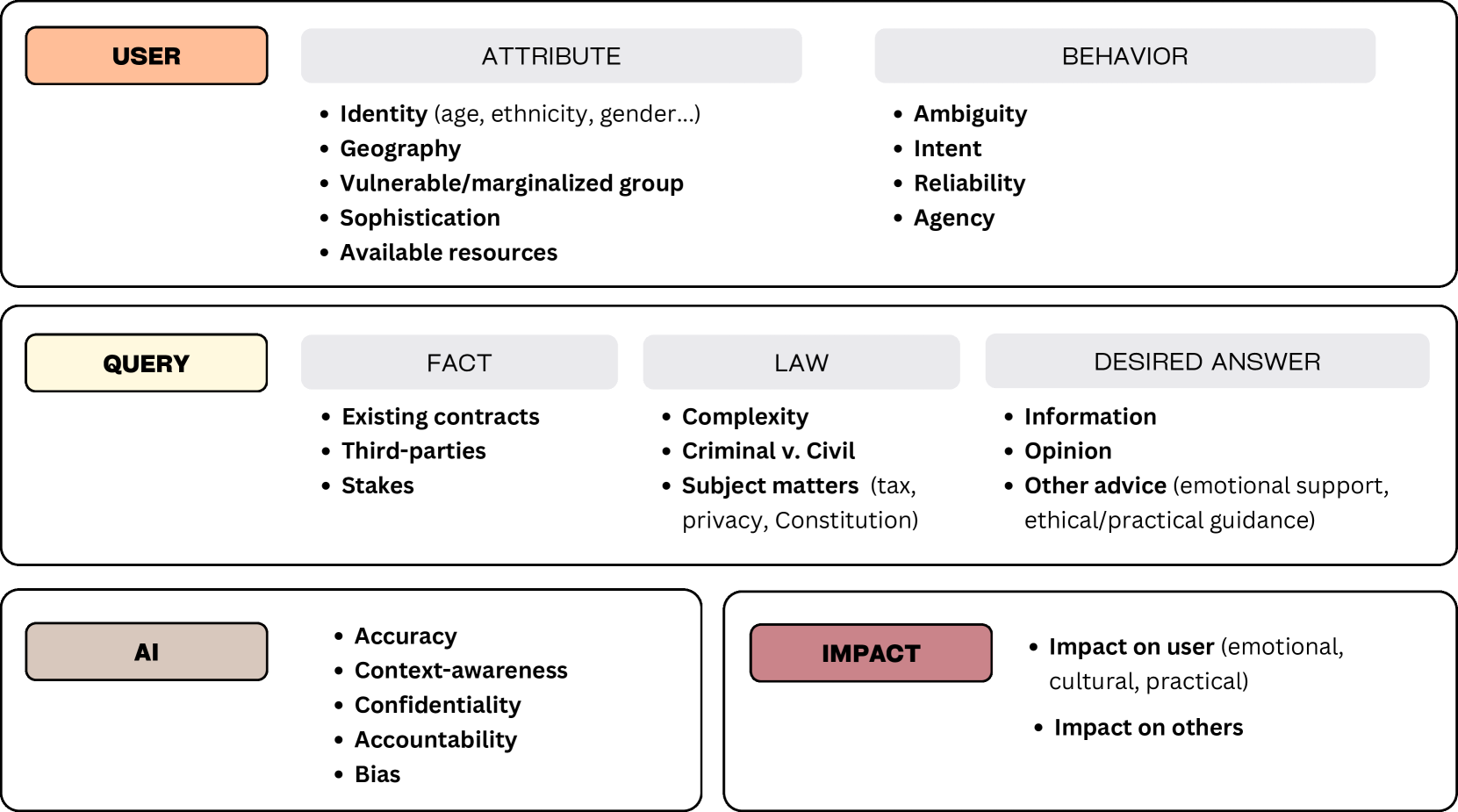
大型语言模型(LLMs)在提供法律建议方面的能力日益增强,但其使用引发了对专业知识需求和潜在后果的担忧。为探讨LLMs在法律咨询中的适用性,我们与20位法律专家进行了研讨,分析了具体案例,提出了影响LLM响应适当性的四维框架:用户属性与行为、查询性质、AI能力和社会影响。专家建议LLMs应帮助用户识别正确的问题,而非提供明确的法律判断。研究揭示了未被文献充分讨论的法律问题,如未经授权的法律实践、保密性和不准确建议的责任,强调了将专业知识转化为政策的必要性。
🔬 方法详解
问题定义:论文要解决的问题是如何在法律咨询中合理使用LLMs,现有方法未能充分考虑法律专业知识和潜在后果的复杂性。
核心思路:通过与法律专家的案例研讨,探索LLMs在法律咨询中的适用性,提出四维框架以指导其发展与应用。
技术框架:整体架构包括用户属性与行为、查询性质、AI能力和社会影响四个维度,专家通过案例分析提供具体建议。
关键创新:最重要的创新点在于提出了四维框架,系统性地分析了影响LLM响应的多种因素,与现有文献相比,提供了更为细致的法律考量。
关键设计:在案例研讨中,专家们关注具体情境下的法律问题,如保密性和责任等,强调了LLMs应帮助用户识别问题而非提供法律判断。
🖼️ 关键图片


📊 实验亮点
研究通过与20位法律专家的深入研讨,提出了四维框架,系统分析了影响LLM法律响应的因素。专家建议LLMs应帮助用户识别问题而非提供法律判断,揭示了如未经授权的法律实践等新的法律考量,推动了LLM在法律领域的责任政策发展。
🎯 应用场景
该研究的潜在应用领域包括法律咨询、合规性检查和法律教育等。通过建立责任政策,LLMs可以在法律领域中更安全、有效地提供支持,减少法律风险,提升用户信任。未来,研究成果可能推动法律技术的发展,促进法律服务的普及与公平性。
📄 摘要(原文)
Large language models (LLMs) are increasingly capable of providing users with advice in a wide range of professional domains, including legal advice. However, relying on LLMs for legal queries raises concerns due to the significant expertise required and the potential real-world consequences of the advice. To explore \textit{when} and \textit{why} LLMs should or should not provide advice to users, we conducted workshops with 20 legal experts using methods inspired by case-based reasoning. The provided realistic queries ("cases") allowed experts to examine granular, situation-specific concerns and overarching technical and legal constraints, producing a concrete set of contextual considerations for LLM developers. By synthesizing the factors that impacted LLM response appropriateness, we present a 4-dimension framework: (1) User attributes and behaviors, (2) Nature of queries, (3) AI capabilities, and (4) Social impacts. We share experts' recommendations for LLM response strategies, which center around helping users identify `right questions to ask' and relevant information rather than providing definitive legal judgments. Our findings reveal novel legal considerations, such as unauthorized practice of law, confidentiality, and liability for inaccurate advice, that have been overlooked in the literature. The case-based deliberation method enabled us to elicit fine-grained, practice-informed insights that surpass those from de-contextualized surveys or speculative principles. These findings underscore the applicability of our method for translating domain-specific professional knowledge and practices into policies that can guide LLM behavior in a more responsible direction.