Large Multi-Modal Models (LMMs) as Universal Foundation Models for AI-Native Wireless Systems
作者: Shengzhe Xu, Christo Kurisummoottil Thomas, Omar Hashash, Nikhil Muralidhar, Walid Saad, Naren Ramakrishnan
分类: cs.NI, cs.AI, cs.CL, cs.LG
发布日期: 2024-01-30 (更新: 2024-02-07)
💡 一句话要点
提出大型多模态模型以解决无线网络AI原生系统的挑战
🎯 匹配领域: 支柱九:具身大模型 (Embodied Foundation Models)
关键词: 大型多模态模型 无线网络 人工智能 因果推理 动态网络适应 检索增强生成 逻辑推理
📋 核心要点
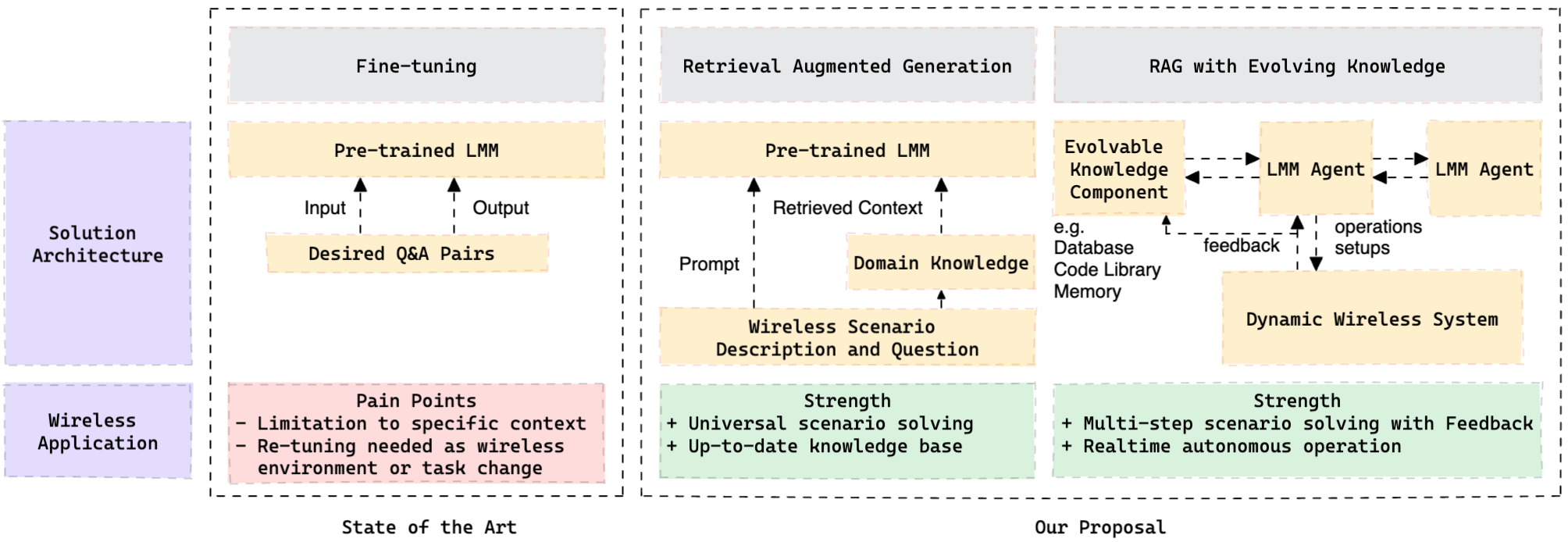
- 现有的LLMs在无线网络中的应用主要依赖于为NLP设计的模型,缺乏针对无线系统的专门优化。
- 本文提出了一种大型多模态模型(LMMs)框架,强调多模态数据处理和因果推理,以适应无线网络的动态需求。
- 实验结果显示,LMMs在数学推理方面的表现优于传统LLMs,展示了其在无线系统设计中的有效性。
📝 摘要(中文)
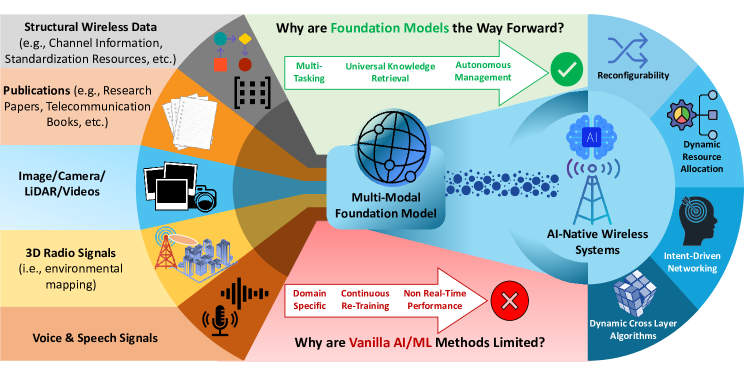
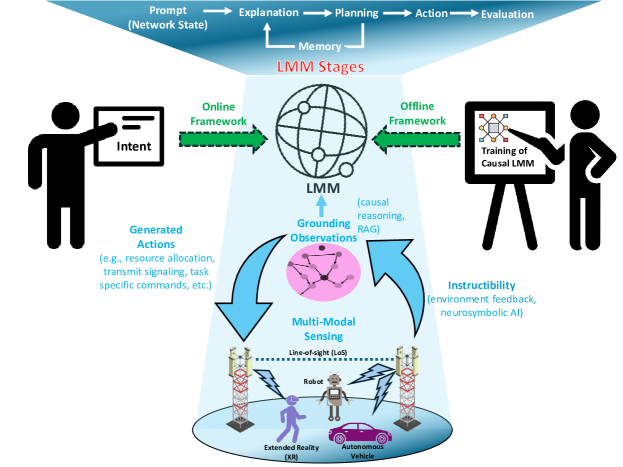
大型语言模型(LLMs)和基础模型被认为是6G系统的变革者。然而,现有的LLMs在无线网络中的应用主要局限于直接使用为自然语言处理(NLP)设计的模型。为了解决这一挑战,本文提出了一种设计通用基础模型的全面愿景,旨在为人工智能(AI)原生网络的部署量身定制。该框架强调大型多模态模型(LMMs)的设计,具备处理多模态传感数据、利用因果推理和检索增强生成(RAG)将物理符号表示与现实无线系统相结合的能力,以及从无线环境反馈中获取指令以促进动态网络适应的能力。初步实验结果表明,LMMs在RAG的支持下有效实现了基础能力的构建,并展示了与无线系统设计的对齐。最后,本文提出了一系列开放性问题和挑战,并给出了一些建议,以推动LMM赋能的AI原生系统的发展。
🔬 方法详解
问题定义:本文旨在解决现有大型语言模型在无线网络应用中的局限性,特别是缺乏针对无线系统的优化和适应能力。
核心思路:提出大型多模态模型(LMMs),通过整合多模态传感数据和因果推理,设计出适合无线环境的基础模型,以实现动态网络适应。
技术框架:LMMs框架包括三个主要模块:多模态数据处理模块、因果推理与RAG模块,以及基于环境反馈的指令模块,形成一个闭环系统以优化网络性能。
关键创新:LMMs的设计突破了传统NLP模型的限制,强调了因果推理和多模态数据的结合,使其能够在无线网络中实现更高效的动态适应。
关键设计:在模型设计中,采用了特定的损失函数以优化多模态数据的融合,并通过神经符号AI增强逻辑和数学推理能力,确保模型在复杂环境下的稳定性和准确性。
🖼️ 关键图片
📊 实验亮点
实验结果表明,LMMs在数学问题的回答中展现出比传统LLMs更强的逻辑和数学推理能力,验证了RAG在LMMs中的有效性,提升幅度明显,展示了其在无线系统设计中的潜力。
🎯 应用场景
该研究的潜在应用领域包括智能无线网络、自动化网络管理和AI驱动的通信系统。通过实现更高效的网络适应能力,LMMs能够显著提升无线系统的性能和可靠性,推动未来6G及更高代际网络的发展。
📄 摘要(原文)
Large language models (LLMs) and foundation models have been recently touted as a game-changer for 6G systems. However, recent efforts on LLMs for wireless networks are limited to a direct application of existing language models that were designed for natural language processing (NLP) applications. To address this challenge and create wireless-centric foundation models, this paper presents a comprehensive vision on how to design universal foundation models that are tailored towards the deployment of artificial intelligence (AI)-native networks. Diverging from NLP-based foundation models, the proposed framework promotes the design of large multi-modal models (LMMs) fostered by three key capabilities: 1) processing of multi-modal sensing data, 2) grounding of physical symbol representations in real-world wireless systems using causal reasoning and retrieval-augmented generation (RAG), and 3) enabling instructibility from the wireless environment feedback to facilitate dynamic network adaptation thanks to logical and mathematical reasoning facilitated by neuro-symbolic AI. In essence, these properties enable the proposed LMM framework to build universal capabilities that cater to various cross-layer networking tasks and alignment of intents across different domains. Preliminary results from experimental evaluation demonstrate the efficacy of grounding using RAG in LMMs, and showcase the alignment of LMMs with wireless system designs. Furthermore, the enhanced rationale exhibited in the responses to mathematical questions by LMMs, compared to vanilla LLMs, demonstrates the logical and mathematical reasoning capabilities inherent in LMMs. Building on those results, we present a sequel of open questions and challenges for LMMs. We then conclude with a set of recommendations that ignite the path towards LMM-empowered AI-native systems.