Deep Reinforcement Multi-agent Learning framework for Information Gathering with Local Gaussian Processes for Water Monitoring
作者: Samuel Yanes Luis, Dmitriy Shutin, Juan Marchal Gómez, Daniel Gutiérrez Reina, Sergio Toral Marín
分类: cs.AI, cs.LG
发布日期: 2024-01-09
💡 一句话要点
提出深度强化学习框架以优化水质监测的多智能体系统
🎯 匹配领域: 支柱二:RL算法与架构 (RL & Architecture)
关键词: 水质监测 多智能体系统 深度强化学习 局部高斯过程 环境监测 智能决策
📋 核心要点
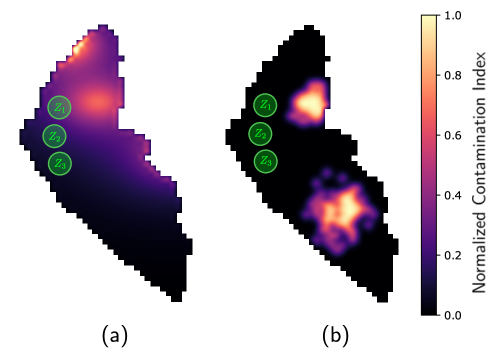
- 现有水质监测方法在处理空间相关性时存在不足,难以准确捕捉水质信息。
- 论文提出结合局部高斯过程与深度强化学习的策略,能够更有效地进行水质监测。
- 实验结果显示,所提方法在监测水质变量和藻类繁殖方面,平均估计误差分别降低了20%和24%。
📝 摘要(中文)
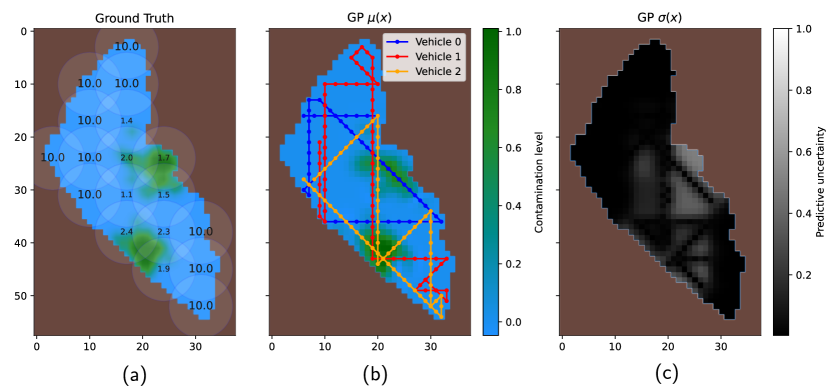
本论文提出了一种由自主水面车辆组成的多智能体系统,用于高效监测水质。为实现安全的舰队控制,舰队策略需基于测量和舰队状态进行决策。论文采用局部高斯过程和深度强化学习共同获得有效的监测策略。局部高斯过程能够准确建模不同空间相关性的信息,从而更好地捕捉水质信息。通过双深度Q学习算法,训练智能体在安全的情况下最小化估计误差。仿真结果表明,所提模型在平均绝对误差方面提升了24%。
🔬 方法详解
问题定义:本研究旨在解决水质监测中现有方法在空间相关性建模上的不足,导致监测数据的准确性和可靠性降低。
核心思路:通过引入局部高斯过程,论文能够更好地捕捉水质信息的空间变化,同时结合深度强化学习优化监测策略,以实现高效的决策制定。
技术框架:整体架构包括局部高斯过程模型用于信息建模,深度卷积策略网络用于决策制定,以及双深度Q学习算法用于智能体训练,确保在安全的条件下优化监测策略。
关键创新:最重要的创新在于使用局部高斯过程替代传统的全局高斯过程,从而更准确地反映水质信息的空间相关性,提升了监测策略的有效性。
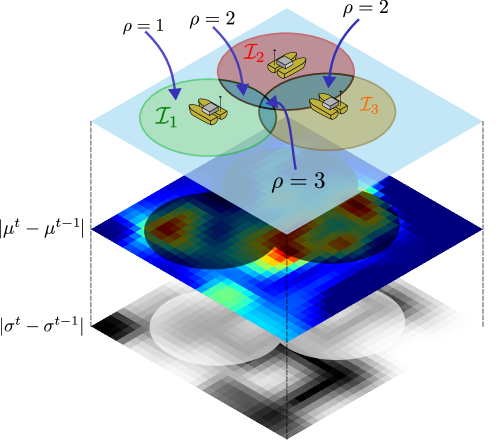
关键设计:在网络结构上,采用深度卷积网络来处理观测数据,损失函数设计为信息增益奖励,以引导智能体在决策时考虑信息的均值和方差。
🖼️ 关键图片
📊 实验亮点
实验结果表明,所提模型在监测水质变量和藻类繁殖方面,平均估计误差分别降低了20%和24%。与现有最先进的方法相比,提出的模型在平均绝对误差上提升了高达24%。
🎯 应用场景
该研究的潜在应用领域包括水资源管理、环境监测和生态保护等。通过提高水质监测的准确性和效率,能够为政策制定和环境保护提供科学依据,具有重要的实际价值和社会影响。
📄 摘要(原文)
The conservation of hydrological resources involves continuously monitoring their contamination. A multi-agent system composed of autonomous surface vehicles is proposed in this paper to efficiently monitor the water quality. To achieve a safe control of the fleet, the fleet policy should be able to act based on measurements and to the the fleet state. It is proposed to use Local Gaussian Processes and Deep Reinforcement Learning to jointly obtain effective monitoring policies. Local Gaussian processes, unlike classical global Gaussian processes, can accurately model the information in a dissimilar spatial correlation which captures more accurately the water quality information. A Deep convolutional policy is proposed, that bases the decisions on the observation on the mean and variance of this model, by means of an information gain reward. Using a Double Deep Q-Learning algorithm, agents are trained to minimize the estimation error in a safe manner thanks to a Consensus-based heuristic. Simulation results indicate an improvement of up to 24% in terms of the mean absolute error with the proposed models. Also, training results with 1-3 agents indicate that our proposed approach returns 20% and 24% smaller average estimation errors for, respectively, monitoring water quality variables and monitoring algae blooms, as compared to state-of-the-art approaches