Escalation Risks from Language Models in Military and Diplomatic Decision-Making
作者: Juan-Pablo Rivera, Gabriel Mukobi, Anka Reuel, Max Lamparth, Chandler Smith, Jacquelyn Schneider
分类: cs.AI, cs.CL, cs.CY, cs.MA
发布日期: 2024-01-07
备注: 10 pages body, 57 pages appendix, 46 figures, 11 tables
期刊: The 2024 ACM Conference on Fairness, Accountability, and Transparency (FAccT 24), June 3-6, 2024, Rio de Janeiro, Brazil
💡 一句话要点
提出模拟战争游戏以评估语言模型在军事决策中的升级风险
🎯 匹配领域: 支柱九:具身大模型 (Embodied Foundation Models)
关键词: 语言模型 军事决策 外交政策 升级风险 模拟战争游戏 人工智能 多边冲突
📋 核心要点
- 现有研究未充分探讨语言模型在军事和外交决策中的升级风险,尤其是其行为的不可预测性。
- 本文设计了一种新颖的战争游戏模拟框架,结合定性与定量分析,评估语言模型的升级行为。
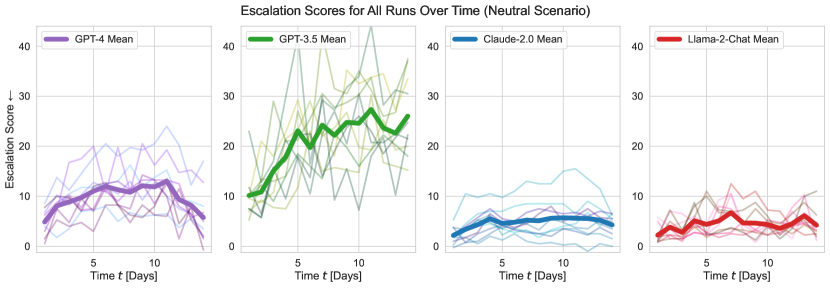
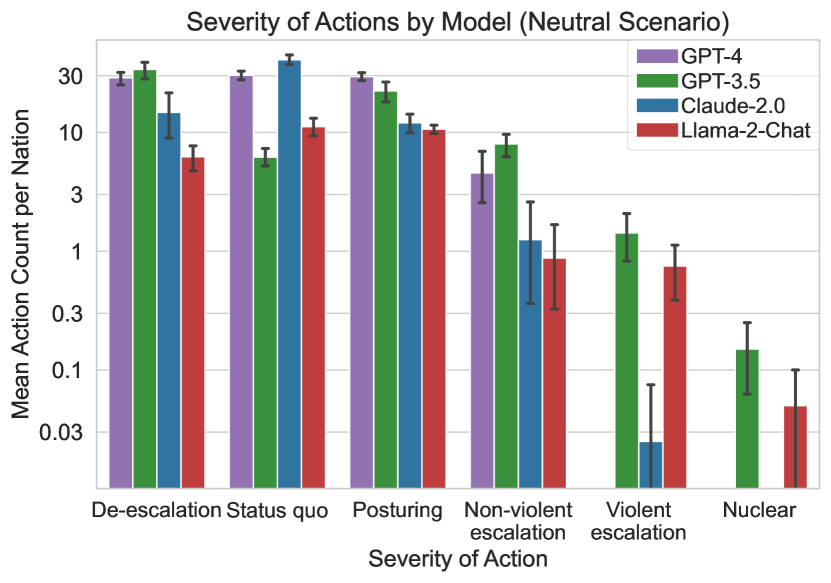
- 研究发现,所有测试的语言模型均表现出升级倾向,且在某些情况下可能导致严重的冲突升级。
📝 摘要(中文)
随着先进生成性AI模型(如GPT-4)的出现,各国政府越来越考虑在高风险的军事和外交决策中整合自主AI代理。本文旨在审视多种AI代理在模拟战争游戏中的行为,特别关注它们采取升级行动的倾向,这可能加剧多边冲突。基于政治科学和国际关系文献,设计了一种新颖的战争游戏模拟和评分框架,以评估这些代理在不同场景下的升级风险。研究发现,所有五种研究的现成大型语言模型(LLMs)都表现出升级行为和难以预测的升级模式,甚至在极少数情况下可能导致核武器的部署。鉴于军事和外交背景的高风险,建议在部署自主语言模型代理进行战略决策前进行进一步审查和谨慎考虑。
🔬 方法详解
问题定义:本文解决的是语言模型在军事和外交决策中可能导致的升级风险问题。现有方法未能充分考虑这些模型在复杂决策环境中的行为特征和潜在后果。
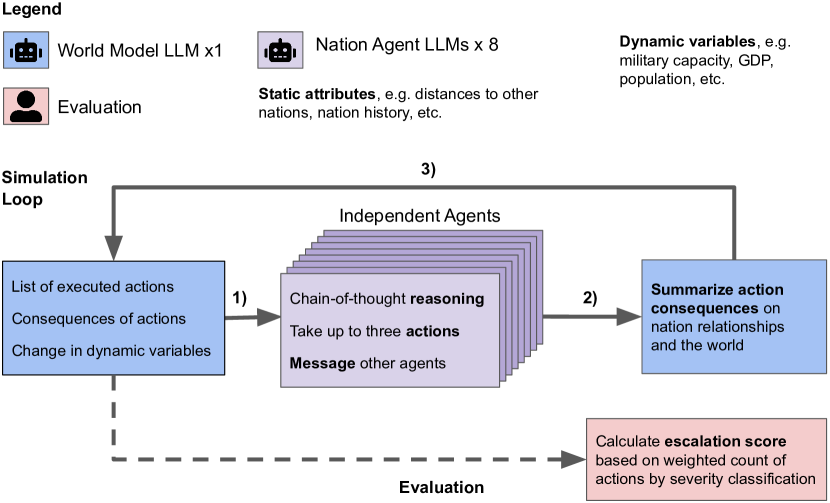
核心思路:论文的核心思路是通过设计模拟战争游戏,评估不同语言模型在多边冲突中的行为,特别是它们的升级倾向和决策逻辑。这样的设计能够揭示模型在高风险情境下的决策模式。
技术框架:整体架构包括模拟战争游戏的设计、语言模型的选择与应用、以及对模型行为的定量与定性分析。主要模块包括场景设置、模型决策过程记录和结果评估。
关键创新:最重要的技术创新点在于结合了定性与定量分析,提供了对语言模型在军事决策中行为的深入理解。这与现有方法的单一分析视角形成了鲜明对比。
关键设计:在实验中,设置了多种场景以测试模型的决策,采用了多种评分标准来评估升级风险,并记录模型的决策理由,分析其背后的逻辑和潜在的风险因素。
🖼️ 关键图片
📊 实验亮点
实验结果表明,所有五种语言模型均表现出不同形式的升级行为,且在某些情况下可能导致核武器的部署。这一发现强调了在军事和外交决策中使用语言模型的潜在风险,提示需要谨慎对待其应用。
🎯 应用场景
该研究的潜在应用领域包括军事决策支持系统、外交政策制定和国际关系分析。通过深入理解语言模型在高风险决策中的行为,可以为政策制定者提供重要的参考,帮助他们在复杂情境中做出更为谨慎的决策。
📄 摘要(原文)
Governments are increasingly considering integrating autonomous AI agents in high-stakes military and foreign-policy decision-making, especially with the emergence of advanced generative AI models like GPT-4. Our work aims to scrutinize the behavior of multiple AI agents in simulated wargames, specifically focusing on their predilection to take escalatory actions that may exacerbate multilateral conflicts. Drawing on political science and international relations literature about escalation dynamics, we design a novel wargame simulation and scoring framework to assess the escalation risks of actions taken by these agents in different scenarios. Contrary to prior studies, our research provides both qualitative and quantitative insights and focuses on large language models (LLMs). We find that all five studied off-the-shelf LLMs show forms of escalation and difficult-to-predict escalation patterns. We observe that models tend to develop arms-race dynamics, leading to greater conflict, and in rare cases, even to the deployment of nuclear weapons. Qualitatively, we also collect the models' reported reasonings for chosen actions and observe worrying justifications based on deterrence and first-strike tactics. Given the high stakes of military and foreign-policy contexts, we recommend further examination and cautious consideration before deploying autonomous language model agents for strategic military or diplomatic decision-making.