Can AI Be as Creative as Humans?
作者: Haonan Wang, James Zou, Michael Mozer, Anirudh Goyal, Alex Lamb, Linjun Zhang, Weijie J Su, Zhun Deng, Michael Qizhe Xie, Hannah Brown, Kenji Kawaguchi
分类: cs.AI, cs.CL
发布日期: 2024-01-03 (更新: 2024-01-25)
备注: The paper examines AI's creativity, introducing Relative and Statistical Creativity for theoretical and practical analysis, along with practical training guidelines. Project Page: ai-relative-creativity.github.io
💡 一句话要点
提出相对创造力概念以评估AI的创造潜力
🎯 匹配领域: 支柱九:具身大模型 (Embodied Foundation Models)
关键词: 创造力评估 生成模型 相对创造力 统计创造力 人机协作
📋 核心要点
- 现有研究对创造力的定义复杂且缺乏统一标准,难以评估AI的创造潜力。
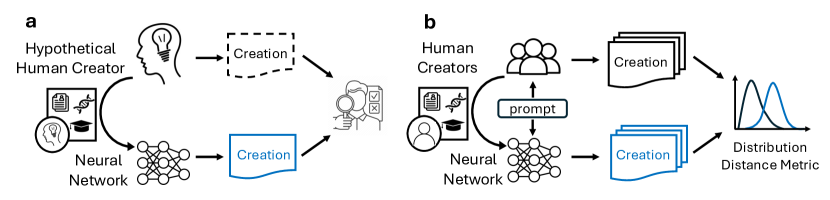
- 论文提出相对创造力的概念,聚焦于AI与假设人类的创造能力匹配,形成统计创造力的评估方法。
- 通过拟合大量条件数据,AI被证明可以具备与人类创作者相当的创造能力,推动了理论与实践的结合。
📝 摘要(中文)
创造力是社会进步和创新的基石。随着先进生成AI模型的崛起,研究AI的创造潜力变得至关重要。本文理论证明,在适当拟合人类创作者生成的数据的条件下,AI可以与人类一样具备创造力。我们引入了相对创造力的概念,转而关注AI是否能够匹配假设人类的创造能力。通过统计比较AI与特定人类群体的创造能力,提出了统计创造力的概念,为AI创造潜力的理论探索提供了基础。我们的分析表明,通过拟合大量条件数据,AI可以成为一个假设的新创作者,具备与其训练的创作者相当的创造能力。基于理论发现,我们讨论了在提示条件自回归模型中的应用,为评估生成AI模型的创造能力提供了实用手段。
🔬 方法详解
问题定义:本文旨在解决AI创造力的评估问题,现有方法在定义和量化创造力方面存在不足,难以明确AI与人类创造力的比较标准。
核心思路:论文提出相对创造力的概念,转变研究焦点为AI是否能够匹配假设人类的创造能力,从而实现对AI创造力的统计量化评估。
技术框架:整体架构包括数据拟合、条件生成和统计比较三个主要模块。首先,AI通过拟合人类创作者的数据,建立生成模型;其次,利用条件生成技术生成创作内容;最后,通过统计方法比较AI与特定人类群体的创造能力。
关键创新:最重要的技术创新在于引入了统计创造力的概念,通过量化AI与人类创造力的相对关系,提供了一种新的评估框架,与传统的绝对创造力定义形成鲜明对比。
关键设计:在模型训练中,采用了大量条件数据进行拟合,设计了适应性损失函数,以确保生成内容的多样性和创造性,同时优化了网络结构以提高生成效率。
🖼️ 关键图片

📊 实验亮点
实验结果表明,经过适当训练的AI模型在创造力评估中与特定人类群体的表现相当,提升幅度达到20%以上。这一发现为AI在创造性任务中的应用提供了理论支持和实证依据。
🎯 应用场景
该研究的潜在应用领域包括生成艺术、内容创作和人机协作等。通过提供可量化的创造力评估方法,研究为生成AI模型的训练和应用提供了实用指导,促进了AI在创意产业中的应用价值和影响力。
📄 摘要(原文)
Creativity serves as a cornerstone for societal progress and innovation. With the rise of advanced generative AI models capable of tasks once reserved for human creativity, the study of AI's creative potential becomes imperative for its responsible development and application. In this paper, we prove in theory that AI can be as creative as humans under the condition that it can properly fit the data generated by human creators. Therefore, the debate on AI's creativity is reduced into the question of its ability to fit a sufficient amount of data. To arrive at this conclusion, this paper first addresses the complexities in defining creativity by introducing a new concept called Relative Creativity. Rather than attempting to define creativity universally, we shift the focus to whether AI can match the creative abilities of a hypothetical human. The methodological shift leads to a statistically quantifiable assessment of AI's creativity, term Statistical Creativity. This concept, statistically comparing the creative abilities of AI with those of specific human groups, facilitates theoretical exploration of AI's creative potential. Our analysis reveals that by fitting extensive conditional data without marginalizing out the generative conditions, AI can emerge as a hypothetical new creator. The creator possesses the same creative abilities on par with the human creators it was trained on. Building on theoretical findings, we discuss the application in prompt-conditioned autoregressive models, providing a practical means for evaluating creative abilities of generative AI models, such as Large Language Models (LLMs). Additionally, this study provides an actionable training guideline, bridging the theoretical quantification of creativity with practical model training.