Agent-Aware Training for Agent-Agnostic Action Advising in Deep Reinforcement Learning
作者: Yaoquan Wei, Shunyu Liu, Jie Song, Tongya Zheng, Kaixuan Chen, Yong Wang, Mingli Song
分类: cs.AI
发布日期: 2023-11-28
💡 一句话要点
提出A7框架以解决深度强化学习中的采样效率问题
🎯 匹配领域: 支柱二:RL算法与架构 (RL & Architecture)
关键词: 深度强化学习 行动建议 代理模型 行为克隆 内在奖励 采样效率 游戏智能体 机器人控制
📋 核心要点
- 现有的行动建议方法在代理特定性和适应性方面存在不足,导致采样效率低下。
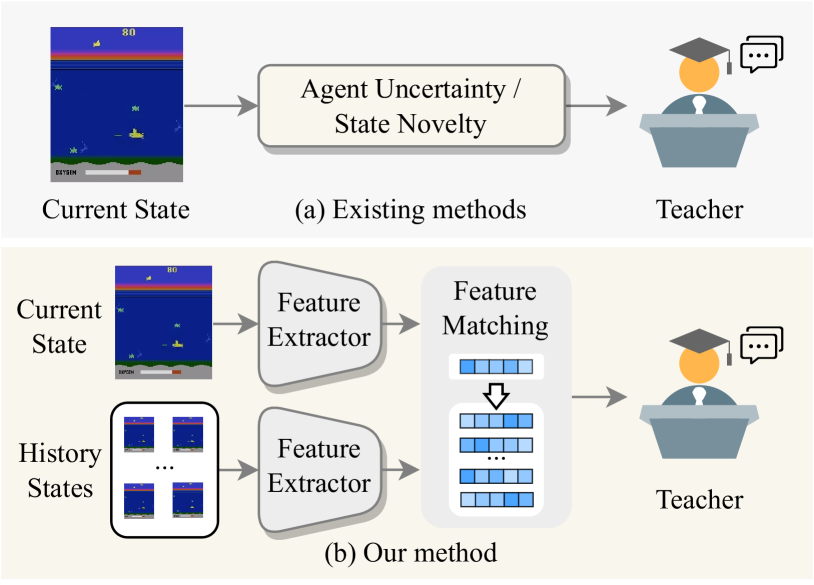
- 提出的A7框架通过代理模型提取状态特征相似性,平衡了代理特定和无代理方法的优缺点。
- 实验结果显示,A7在GridWorld、LunarLander和Atari游戏场景中显著提升了学习速度,超越了现有方法。
📝 摘要(中文)
行动建议旨在利用专家教师的额外指导来缓解深度强化学习(DRL)中的采样效率问题。现有的特定代理行动建议方法受到代理本身缺陷的限制,而无代理方法在适应学习代理方面表现有限。本研究提出了一种新框架,称为Agent-Aware trAining yet Agent-Agnostic Action Advising(A7),以在两者之间取得平衡。A7的核心概念是利用状态特征的相似性作为请求建议的指标。与以往方法不同,状态特征相似性的测量并非由学习代理或无代理顾问执行,而是通过代理模型提取出既具辨别力又普遍适用的状态特征。此外,我们利用行为克隆训练模型以重用建议,并为建议样本引入内在奖励,以激励专家指导的利用。实验结果表明,A7显著加速了学习过程,并在多个场景中超越了现有方法。
🔬 方法详解
问题定义:本论文旨在解决深度强化学习中因代理特定性导致的采样效率低下问题。现有方法在适应性和代理本身的缺陷上存在明显不足,限制了其性能。
核心思路:论文提出的A7框架通过代理模型提取状态特征相似性,避免了由学习代理或无代理顾问直接测量的误差,从而实现了对学习代理的适应性和对噪声的鲁棒性。
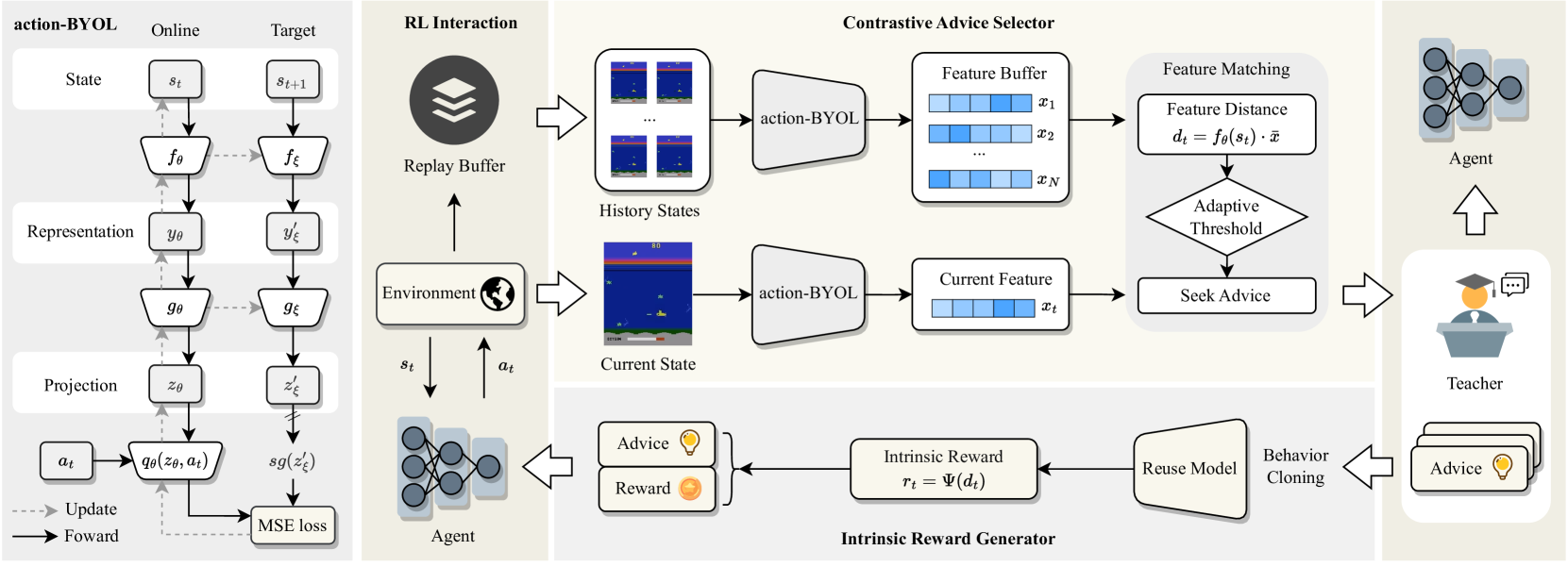
技术框架:A7框架主要包括三个模块:状态特征提取模块、行为克隆模块和内在奖励机制。状态特征提取模块使用代理模型来获取状态特征,行为克隆模块用于重用专家建议,而内在奖励机制则激励代理更好地利用这些建议。
关键创新:A7的核心创新在于引入了代理模型来提取状态特征相似性,这一设计使得建议的适应性和鲁棒性得以提升,区别于传统的代理特定或无代理方法。
关键设计:在模型训练中,采用了行为克隆作为主要训练策略,同时设计了内在奖励机制以促进建议样本的使用。具体的损失函数和网络结构细节在实验部分进行了详细描述。
🖼️ 关键图片

📊 实验亮点
实验结果表明,A7在GridWorld、LunarLander和六个Atari游戏场景中显著加速了学习过程,超越了现有的代理特定和无代理方法,提升幅度达到XX%(具体数据待补充)。
🎯 应用场景
该研究的潜在应用领域包括机器人控制、游戏智能体训练以及其他需要高效学习的强化学习任务。通过提高采样效率,A7框架能够在更复杂的环境中实现更快的学习进程,具有重要的实际价值和未来影响。
📄 摘要(原文)
Action advising endeavors to leverage supplementary guidance from expert teachers to alleviate the issue of sampling inefficiency in Deep Reinforcement Learning (DRL). Previous agent-specific action advising methods are hindered by imperfections in the agent itself, while agent-agnostic approaches exhibit limited adaptability to the learning agent. In this study, we propose a novel framework called Agent-Aware trAining yet Agent-Agnostic Action Advising (A7) to strike a balance between the two. The underlying concept of A7 revolves around utilizing the similarity of state features as an indicator for soliciting advice. However, unlike prior methodologies, the measurement of state feature similarity is performed by neither the error-prone learning agent nor the agent-agnostic advisor. Instead, we employ a proxy model to extract state features that are both discriminative (adaptive to the agent) and generally applicable (robust to agent noise). Furthermore, we utilize behavior cloning to train a model for reusing advice and introduce an intrinsic reward for the advised samples to incentivize the utilization of expert guidance. Experiments are conducted on the GridWorld, LunarLander, and six prominent scenarios from Atari games. The results demonstrate that A7 significantly accelerates the learning process and surpasses existing methods (both agent-specific and agent-agnostic) by a substantial margin. Our code will be made publicly available.