Meta Prompting for AI Systems
作者: Yifan Zhang, Yang Yuan, Andrew Chi-Chih Yao
分类: cs.AI, cs.CL
发布日期: 2023-11-20 (更新: 2025-12-18)
备注: Project Page: https://github.com/meta-prompting/meta-prompting
🔗 代码/项目: GITHUB
💡 一句话要点
提出Meta Prompting框架以提升大语言模型推理能力
🎯 匹配领域: 支柱九:具身大模型 (Embodied Foundation Models)
关键词: 大语言模型 推理能力 Meta Prompting 递归Meta Prompting 自动化提示工程 模块化提示 token效率 自我优化
📋 核心要点
- 现有方法在处理复杂推理任务时,往往依赖于具体的内容示例,导致灵活性和效率不足。
- 论文提出Meta Prompting框架,强调任务的形式结构,允许系统性地分解问题解决策略为模块化提示。
- 实验结果显示,Qwen-72B模型在多个基准测试上表现优异,且在token使用效率上显著优于传统方法。
📝 摘要(中文)
我们介绍了Meta Prompting(MP)框架,通过关注任务的形式结构而非内容特定示例,提升大型语言模型(LLMs)的推理能力。我们为这一范式建立了理论基础,将MP形式化为一个函子,能够将任务类别映射到结构化提示类别,从而保证组合问题解决策略可以系统性地分解为模块化提示结构。我们进一步扩展了递归Meta Prompting(RMP)的概念,提出一种自动化过程,使LLM能够生成和优化自身提示。我们将这一自我改进循环形式化为单子,为自动化提示工程提供了原则性框架。通过大量实验验证,我们的Qwen-72B基础模型在MATH、GSM8K和Game of 24任务上,借助单一的与示例无关的元提示,达到了最先进的结果,并在传统少样本方法上实现了显著的token效率提升。
🔬 方法详解
问题定义:本论文旨在解决大型语言模型在推理任务中对具体内容示例的依赖问题,现有方法往往缺乏灵活性和效率,难以适应多样化的任务需求。
核心思路:提出Meta Prompting框架,通过关注任务的形式结构而非具体示例,系统性地将问题解决策略分解为模块化的提示结构,从而提升模型的推理能力和效率。
技术框架:整体架构包括两个主要模块:Meta Prompting(MP)和递归Meta Prompting(RMP)。MP负责将任务映射到结构化提示,而RMP则实现模型自我生成和优化提示的自动化过程。
关键创新:最重要的技术创新在于将MP形式化为一个函子,并将RMP建模为单子,这为自动化提示工程提供了理论基础和实践框架,显著提高了模型的自适应能力。
关键设计:在提示生成过程中,设计了与任务无关的元提示,确保模型能够在不同任务上保持高效表现,同时在实验中通过优化token使用,提升了整体性能。
🖼️ 关键图片
📊 实验亮点
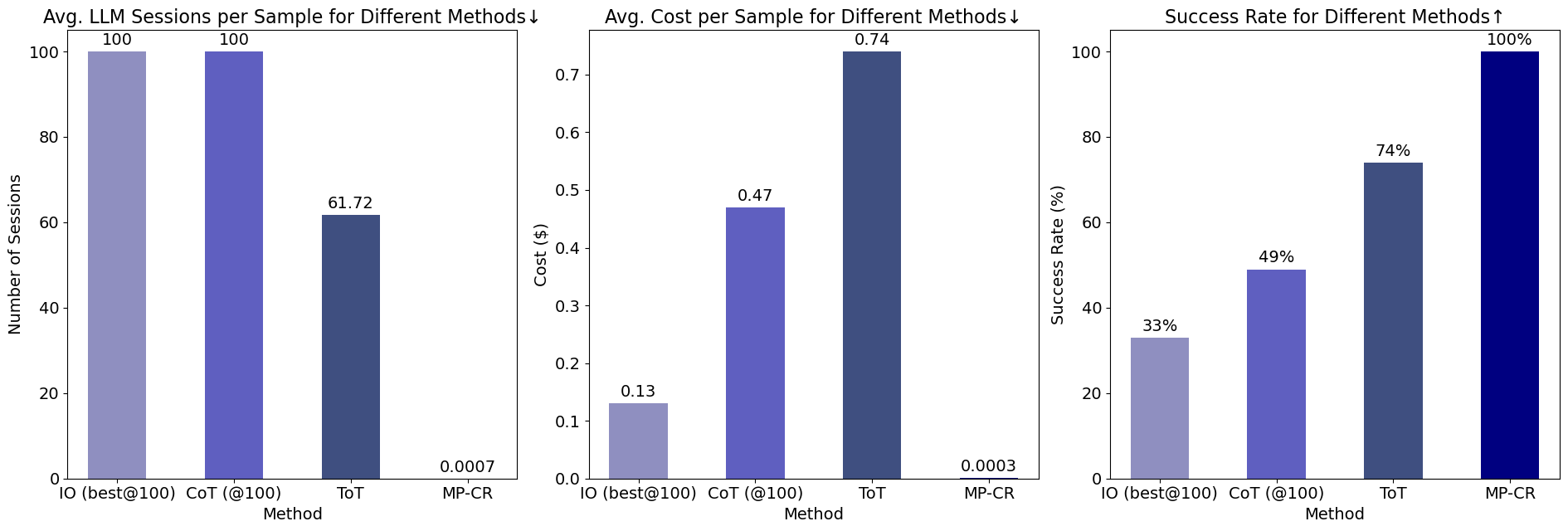
实验结果表明,Qwen-72B基础模型在MATH、GSM8K和Game of 24任务上,借助单一的元提示,达到了最先进的性能,且在token使用效率上相比传统少样本方法提升显著,展示了Meta Prompting的有效性。
🎯 应用场景
该研究的潜在应用领域包括教育、金融、游戏等需要复杂推理的场景。通过提升大语言模型的推理能力,Meta Prompting框架能够为智能助手、自动化决策系统等提供更高效的解决方案,未来可能对人机交互和智能系统的发展产生深远影响。
📄 摘要(原文)
We introduce Meta Prompting (MP), a framework that elevates the reasoning capabilities of large language models (LLMs) by focusing on the formal structure of a task rather than content-specific examples. We establish a theoretical foundation for this paradigm, formalizing MP as a functor that maps a category of tasks to a category of structured prompts, thereby guaranteeing that compositional problem-solving strategies can be systematically decomposed into modular prompt structures. We extend this concept to Recursive Meta Prompting (RMP), an automated process where an LLM can generate and refine its own prompts. We model this self-improvement loop formally as a monad, providing a principled framework for automated prompt engineering. Our claims are validated through extensive experiments demonstrating that a Qwen-72B base model, guided by a single, example-agnostic meta-prompt, achieves state-of-the-art results on MATH, GSM8K, and Game of 24. These results are achieved with substantial token efficiency gains over traditional few-shot methods. Project Page: https://github.com/meta-prompting/meta-prompting.