MultiDelete for Multimodal Machine Unlearning
作者: Jiali Cheng, Hadi Amiri
分类: cs.AI, cs.CL, cs.CV, cs.LG
发布日期: 2023-11-18 (更新: 2024-07-15)
备注: ECCV 2024
💡 一句话要点
提出MultiDelete以解决多模态机器遗忘问题
🎯 匹配领域: 支柱九:具身大模型 (Embodied Foundation Models)
关键词: 机器遗忘 多模态学习 模态解耦 知识保留 对抗攻击
📋 核心要点
- 现有的机器遗忘方法在多模态数据中面临模态间复杂依赖性和高昂的训练成本等挑战。
- 本文提出的MultiDelete方法通过解耦单模态数据点的关联,实现有效的多模态遗忘,同时保留模型的整体表示能力。
- 实验结果显示,MultiDelete在四个数据集上平均提升17.6个百分点,并能保持模型的多模态和单模态知识。
📝 摘要(中文)
机器遗忘技术旨在从已训练模型中移除特定训练数据样本的知识,具有清除私人、错误或过时信息的显著实用价值。然而,在多模态环境中,遗忘面临复杂的模态依赖性和训练成本高昂的问题。本文提出了首个针对多模态数据和模型的机器遗忘方法MultiDelete,旨在在不损失整体表示能力的情况下,解耦单模态数据点之间的关联。MultiDelete强调三大关键特性:模态解耦、多模态知识保留和单模态知识保留。实验结果表明,MultiDelete在多模态样本遗忘上平均提升17.6个百分点,并能有效保护未遗忘数据免受对抗攻击。
🔬 方法详解
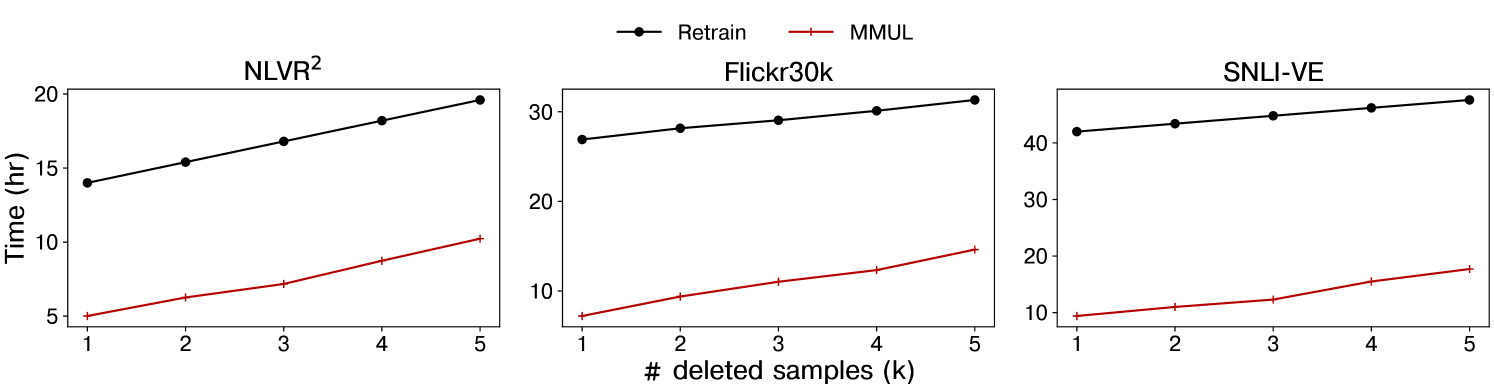
问题定义:本文解决的是在多模态环境中进行机器遗忘的具体问题,现有方法难以处理模态间的复杂依赖性,且通常需要完全重新训练模型,成本高昂。
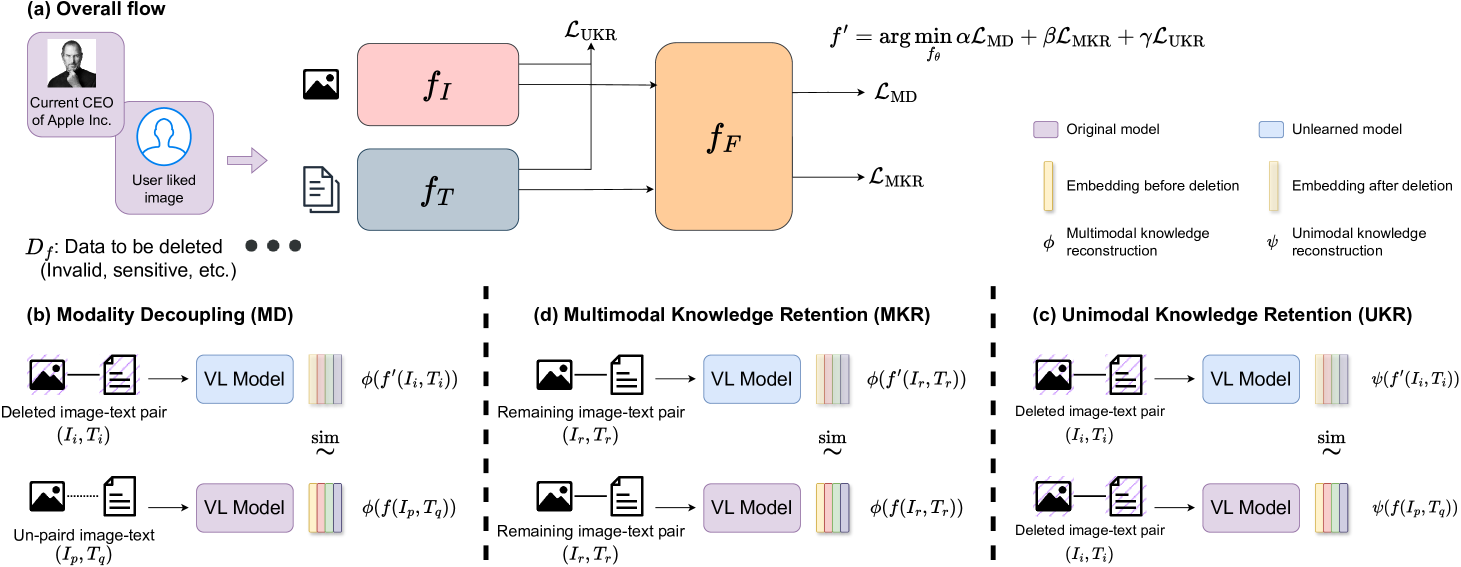
核心思路:MultiDelete的核心思路是通过模态解耦来处理单模态数据点的遗忘,将其视为无关数据点,从而有效地进行多模态遗忘,同时保留模型的整体表示能力。
技术框架:MultiDelete的整体架构包括三个主要模块:模态解耦模块、知识保留模块和训练优化模块。模态解耦模块负责解耦单模态数据点的关联,知识保留模块确保多模态和单模态知识的保留,训练优化模块则提高训练效率。
关键创新:MultiDelete的最重要创新在于其模态解耦能力,使得在遗忘过程中不再依赖于强凸损失函数,这与现有方法的限制形成了鲜明对比。
关键设计:在设计上,MultiDelete采用了特定的损失函数来平衡模态解耦与知识保留,同时在网络结构上进行了优化,以提高训练效率和模型表现。具体参数设置和网络结构细节在实验部分进行了详细描述。
🖼️ 关键图片
📊 实验亮点
实验结果显示,MultiDelete在多模态样本遗忘任务中,相较于最佳基线平均提升17.6个百分点。同时,该方法能够有效保持模型的多模态和单模态知识,并在对抗攻击中提供更好的数据保护。
🎯 应用场景
该研究的潜在应用领域包括数据隐私保护、模型更新和动态学习等场景。通过有效的多模态遗忘,企业和组织能够在不重新训练模型的情况下,快速清除过时或敏感信息,从而提高数据安全性和合规性。未来,该技术可能在智能助手、推荐系统等领域发挥重要作用。
📄 摘要(原文)
Machine Unlearning removes specific knowledge about training data samples from an already trained model. It has significant practical benefits, such as purging private, inaccurate, or outdated information from trained models without the need for complete re-training. Unlearning within a multimodal setting presents unique challenges due to the complex dependencies between different data modalities and the expensive cost of training on large multimodal datasets and architectures. This paper presents the first machine unlearning approach for multimodal data and models, titled MultiDelete, which is designed to decouple associations between unimodal data points during unlearning without losing the overall representation strength of the trained model. MultiDelete advocates for three key properties for effective multimodal unlearning: (a): modality decoupling, which effectively decouples the association between individual unimodal data points marked for deletion, rendering them as unrelated data points, (b): multimodal knowledge retention, which retains the multimodal representation post-unlearning, and (c): unimodal knowledge retention, which retains the unimodal representation postunlearning. MultiDelete is efficient to train and is not constrained by using a strongly convex loss -- a common restriction among existing baselines. Experiments on two architectures and four datasets, including image-text and graph-text datasets, show that MultiDelete gains an average improvement of 17.6 points over best performing baseline in unlearning multimodal samples, can maintain the multimodal and unimodal knowledge of the original model post unlearning, and can provide better protection to unlearned data against adversarial attacks.