Modeling User Viewing Flow Using Large Language Models for Article Recommendation
作者: Zhenghao Liu, Zulong Chen, Moufeng Zhang, Shaoyang Duan, Hong Wen, Liangyue Li, Nan Li, Yu Gu, Ge Yu
分类: cs.IR, cs.AI
发布日期: 2023-11-12 (更新: 2024-03-07)
备注: Accepted by WebConf 2024
💡 一句话要点
提出用户观看流建模方法以提升文章推荐效果
🎯 匹配领域: 支柱九:具身大模型 (Embodied Foundation Models)
关键词: 用户推荐 观看流建模 大型语言模型 个性化推荐 机器学习
📋 核心要点
- 现有的推荐系统往往无法有效捕捉用户的持续偏好和瞬时兴趣,导致推荐效果不佳。
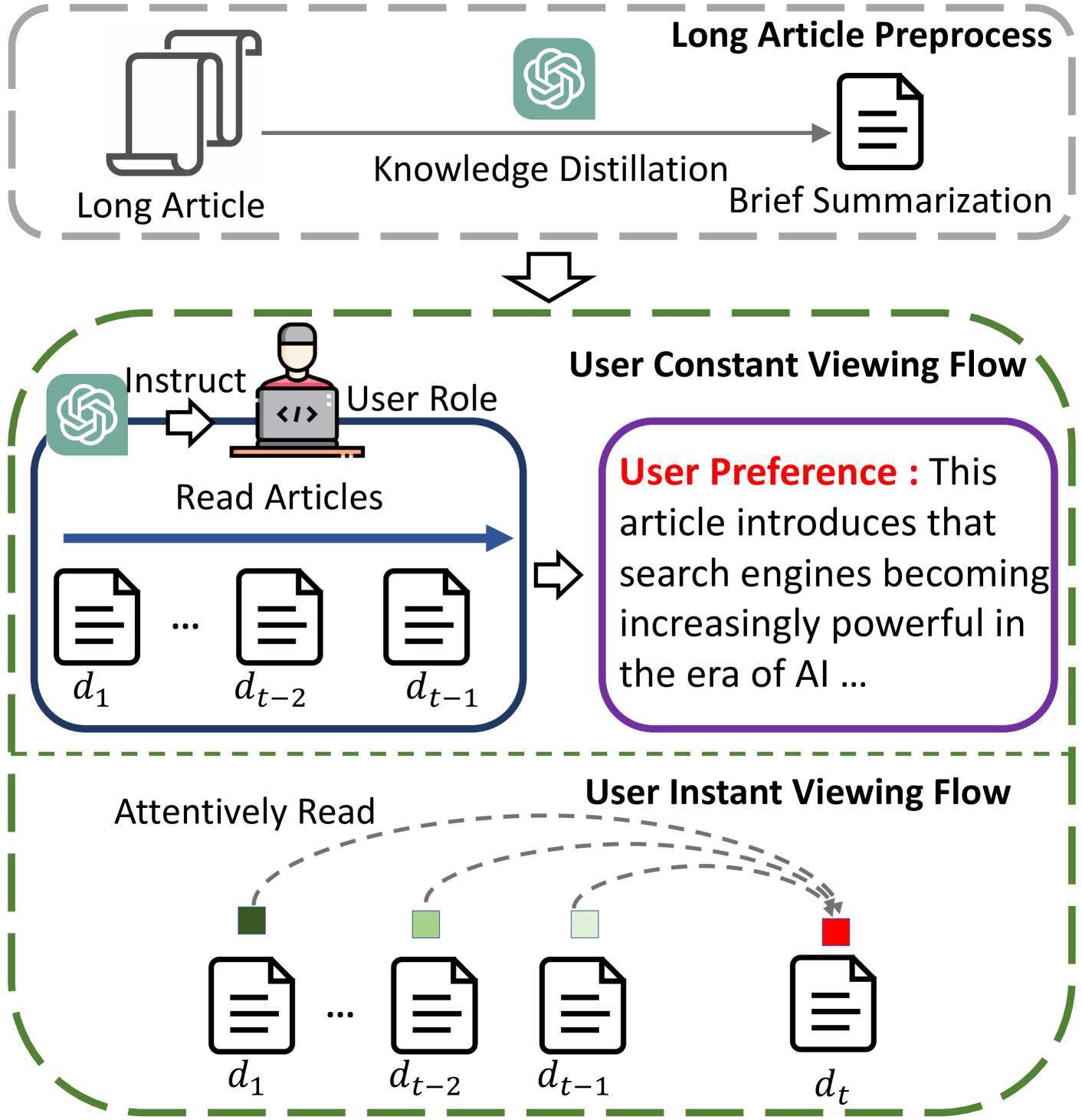
- 本文提出的SINGLE方法通过建模用户的观看流,利用大型语言模型捕捉用户的持续偏好,并结合即时兴趣进行推荐。
- 在阿里巴巴技术协会网站的实验中,SINGLE方法在在线A/B测试中实现了2.4%的性能提升,显示出其有效性。
📝 摘要(中文)
本文提出了一种用户观看流建模方法(SINGLE),用于文章推荐任务,旨在从用户点击的文章中建模用户的持续偏好和即时兴趣。首先,采用用户持续观看流建模方法总结用户的整体兴趣,以推荐相关的文章。接着,设计用户即时观看流建模方法,建立用户点击历史与候选文章之间的交互。实验结果表明,SINGLE在阿里巴巴技术协会网站的在线A/B测试中,相较于之前的基线模型提升了2.4%。进一步分析显示,SINGLE能够通过模拟用户的不同文章观看行为,构建更为个性化的推荐系统,推荐更合适且多样化的文章以匹配用户兴趣。
🔬 方法详解
问题定义:本文旨在解决现有推荐系统无法准确建模用户持续偏好与瞬时兴趣的问题。现有方法往往忽视用户的观看行为变化,导致推荐不够精准。
核心思路:SINGLE方法通过结合用户的持续观看流和即时观看流,利用大型语言模型提取用户的长期兴趣和短期需求,从而实现更精准的推荐。
技术框架:整体架构包括两个主要模块:用户持续观看流建模和用户即时观看流建模。前者总结用户的整体兴趣,后者则关注用户点击历史与候选文章的交互。
关键创新:SINGLE的创新在于同时考虑用户的持续偏好和瞬时兴趣,通过大型语言模型的应用,能够更全面地理解用户的需求,与现有方法相比,提供了更为细致的推荐策略。
关键设计:在设计中,使用了特定的损失函数来优化推荐效果,并通过多层神经网络结构来增强模型的表达能力,确保能够有效捕捉用户的兴趣变化。具体参数设置和网络结构细节在实验部分进行了详细描述。
🖼️ 关键图片

📊 实验亮点
在阿里巴巴技术协会网站的在线A/B测试中,SINGLE方法相较于之前的基线模型实现了2.4%的性能提升,证明了其在个性化推荐方面的有效性。此外,SINGLE能够模拟用户的不同观看行为,推荐更合适且多样化的文章,进一步增强了推荐系统的实用性。
🎯 应用场景
该研究的潜在应用领域包括新闻推荐、社交媒体内容推荐和电子商务产品推荐等。通过更精准的用户兴趣建模,SINGLE方法能够为用户提供更符合其需求的内容,提升用户体验和满意度,具有广泛的实际价值和未来影响。
📄 摘要(原文)
This paper proposes the User Viewing Flow Modeling (SINGLE) method for the article recommendation task, which models the user constant preference and instant interest from user-clicked articles. Specifically, we first employ a user constant viewing flow modeling method to summarize the user's general interest to recommend articles. In this case, we utilize Large Language Models (LLMs) to capture constant user preferences from previously clicked articles, such as skills and positions. Then we design the user instant viewing flow modeling method to build interactions between user-clicked article history and candidate articles. It attentively reads the representations of user-clicked articles and aims to learn the user's different interest views to match the candidate article. Our experimental results on the Alibaba Technology Association (ATA) website show the advantage of SINGLE, achieving a 2.4% improvement over previous baseline models in the online A/B test. Our further analyses illustrate that SINGLE has the ability to build a more tailored recommendation system by mimicking different article viewing behaviors of users and recommending more appropriate and diverse articles to match user interests.