Kindness in Multi-Agent Reinforcement Learning
作者: Farinaz Alamiyan-Harandi, Mersad Hassanjani, Pouria Ramazi
分类: cs.AI, cs.LG
发布日期: 2023-11-06
备注: arXiv admin note: text overlap with arXiv:2302.12053
💡 一句话要点
提出KindMARL以解决多智能体强化学习中的公平性问题
🎯 匹配领域: 支柱二:RL算法与架构 (RL & Architecture)
关键词: 多智能体强化学习 公平性 反事实推理 合作智能体 奖励机制
📋 核心要点
- 现有的多智能体强化学习方法在处理合作与公平性时存在不足,难以有效评估智能体之间的意图与行为。
- 本文提出KindMARL方法,通过反事实推理来衡量智能体的意图,从而促进智能体之间的合作与公平性。
- 实验结果显示,KindMARL在多个环境中显著提高了智能体的总奖励,验证了其在多智能体系统中的有效性。
📝 摘要(中文)
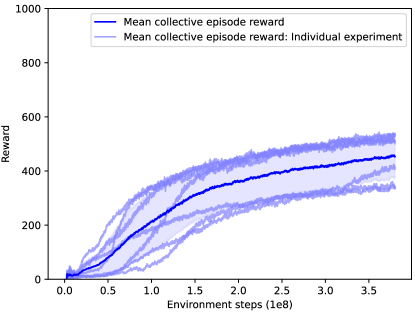
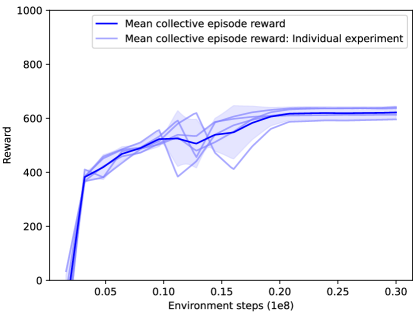
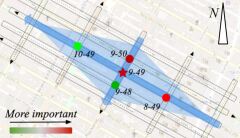
在人类社会中,人们在决策时常常考虑公平性,并对善待他人的行为做出回馈。本文提出KindMARL方法,通过反事实推理评估智能体的意图,以此训练合作性智能体。具体而言,当前环境状态与假设智能体选择其他行动时的环境状态进行比较,从而衡量智能体的“善良”。实验结果表明,KindMARL方法在Cleanup和Harvest环境中显著提高了智能体的总奖励,相较于不公平厌恶和社会影响方法分别提升了89%和37%。此外,在交通信号控制问题中的实验进一步验证了KindMARL的有效性。
🔬 方法详解
问题定义:本文旨在解决多智能体强化学习中智能体之间的公平性与合作性问题。现有方法往往忽视了智能体行为的意图,导致合作效果不佳。
核心思路:KindMARL方法通过反事实推理来评估智能体的意图,比较当前环境状态与假设智能体选择其他行动时的状态,从而衡量智能体的“善良”。这种设计使得智能体能够更好地理解和响应其他智能体的行为。
技术框架:KindMARL的整体架构包括环境状态评估、意图计算和奖励调整三个主要模块。首先,智能体评估当前状态,然后进行反事实推理,最后根据意图调整自身的奖励。
关键创新:最重要的技术创新在于引入反事实推理来衡量智能体的意图,这与传统方法仅依赖于结果的评估方式有本质区别。
关键设计:在参数设置上,KindMARL采用了特定的损失函数来平衡奖励调整与意图评估,网络结构则设计为能够处理多智能体的状态信息,确保高效的计算与反馈。
🖼️ 关键图片
📊 实验亮点
实验结果显示,使用KindMARL方法的智能体在Cleanup和Harvest环境中分别比基线方法获得了89%和37%的奖励提升。此外,在交通信号控制问题中,KindMARL的有效性得到了进一步验证,显示出其在复杂环境中的应用潜力。
🎯 应用场景
KindMARL方法在多智能体系统中具有广泛的应用潜力,特别是在需要合作与公平性的场景,如交通管理、资源分配和社会行为模拟等领域。其有效性不仅提升了智能体的合作能力,也为未来的智能体交互设计提供了新的思路。
📄 摘要(原文)
In human societies, people often incorporate fairness in their decisions and treat reciprocally by being kind to those who act kindly. They evaluate the kindness of others' actions not only by monitoring the outcomes but also by considering the intentions. This behavioral concept can be adapted to train cooperative agents in Multi-Agent Reinforcement Learning (MARL). We propose the KindMARL method, where agents' intentions are measured by counterfactual reasoning over the environmental impact of the actions that were available to the agents. More specifically, the current environment state is compared with the estimation of the current environment state provided that the agent had chosen another action. The difference between each agent's reward, as the outcome of its action, with that of its fellow, multiplied by the intention of the fellow is then taken as the fellow's "kindness". If the result of each reward-comparison confirms the agent's superiority, it perceives the fellow's kindness and reduces its own reward. Experimental results in the Cleanup and Harvest environments show that training based on the KindMARL method enabled the agents to earn 89\% (resp. 37\%) and 44% (resp. 43\%) more total rewards than training based on the Inequity Aversion and Social Influence methods. The effectiveness of KindMARL is further supported by experiments in a traffic light control problem.